Detailed Interface Description
Statistics Panel
Real-time statistics are displayed on the right side of the screen:
- TOTAL TXs DETECTED: Total number of transactions detected on scanned wallets.
- TOTAL WALLETS FOUND: Total number of wallets found that have a transaction history.
- TOTAL BALANCES DETECTED: The most important counter — the number of wallets found with a positive balance.
Sidebar and Bottom functional Buttons
- VIEW KEYS: Button below wallet statistics. Opens the
history_found_keys.txtfile, which saves private keys from wallets with transaction history (but zero balance). Note: This button locks and requires activation after the trial expires. - VIEW FOUNDS: Button below balance statistics. Opens the
found_balance_keys.txtfile, which contains your most valuable findings — keys to wallets with money. - SOUND FX (ON/OFF): Toggles sound notifications (e.g., alert sounds when a wallet with a balance or history is found).
- TURBO MODE (ON/OFF): Forced CPU mode. Activates heavy low-level instructions AVX2 / SSE4.2 for maximum generation speed.
- GPU ACCELERATOR (ON/OFF): Hardware acceleration toggle. Shifts computations from the CPU to your graphics card chip, massively increasing the search speed. Note: If the GPU is still loading, the button will display a lock icon and INITIALIZING ENGINE...
- DISK LOGGING (ON/OFF): Saves detailed logs (api_coverage, scanning data) to the
logs/folder on your hard drive. - Support / Telegram: The buttons at the very bottom of the sidebar open the official website, where you can ask questions in the support chat and read news in the Telegram channel.
Diagnostic & Recovery Tools
These bottom buttons are designed for deep technical analysis and standalone mnemonic phrase reconstruction:
- SEED PHRASE RECOVERY TOOL: Launches the dedicated Seed Phrase Reconstruction tool for recovering damaged or partial 12-word mnemonic phrases.
- ENGINE DATA: Opens the system log
db_engine_1.txt. Here you can view the local database's technical stats: Bloom filter initialization time, RAM allocation for wallet hashes, bit-array size, and False Positive collision probabilities. This log helps determine if your PC has enough memory to hold the massive balance database. - API SCAN: Opens the
scan_data_*.txtfile. This log stores a massive dump of generated keys and their formats. It appears as a stream of lines separated by a|symbol, containing uncompressed keys, compressed keys, Legacy, Segwit addresses. This log is used for manual auditing to verify the correctness of wallet generation. - NETWORK: Opens the
api_coverage_*.txtreport. This log details the scanner's network activity. It displays query statistics to blockchain nodes Haskoin, Mempool, Blockstream: ping/latency in milliseconds, number of addresses checked per batch, server responses (HTTP codes 200, 500, 429), and connection statuses. This log is essential for monitoring API limits and checking if nodes are blocking your IP. - GPU HEALTH: Opens the
gpu_engine.logfile. Relevant when hardware acceleration is enabled. It logs the initialization of the CUDA or OpenCL platform, available Video RAM, shader Block/Grid dimensions, as well as temperature metrics, GPU load, and hashrate (H/s)..
Activation System
- BUY LICENSE: Appears upon trial period ends. Opens your browser to the license purchase page.
- ACTIVATE NOW: Opens a popup window
ENTER ACTIVATION KEY (AI-XXXX-...)with an ACKNOWLEDGE button. Upon successful license key entry, the interface unlocks, and the encrypted files (opened by VIEW KEYS and VIEW FOUNDS) are instantly decrypted.
How to Withdraw Funds & Import into Electrum Wallet
When bitResurrector finds an active balance (via the Private Key Scanner or the Seed Phrase Recovery Module), you can claim the funds using the non-custodial Electrum Bitcoin Wallet. Follow the instructions below based on whether you recovered a Private Key (WIF) or a 12-Word Seed Phrase:
Method 1: Importing Found Private Keys (WIF)
- Download and install Electrum Bitcoin Wallet from the official portal (
electrum.org). - Create a new wallet:
File -> New/Restore -> Import Bitcoin addresses or private keys. - Paste the recovered private key into the input field.
- IMPORTANT (SegWit Prefixes): If the balance was located on a SegWit address, you must prepend the corresponding Electrum script prefix:
- For Native SegWit (bc1q...addresses): addp2wpkh:(Example:p2wpkh:L5V3...)
- For Nested SegWit (3...addresses): addp2wpkh-p2sh:(Example:p2wpkh-p2sh:Kx91...)
- For Legacy Addresses (1...addresses): paste the raw WIF key without any prefix (Example:5J...orL1...). - Click Next, specify a wallet encryption password, and wait for blockchain network synchronization to transfer the balance.
Method 2: Restoring Recovered BIP-39 / Electrum Seed Phrases
- Open Electrum and go to
File -> New/Restore. - Enter a name for your wallet, select Standard wallet, and click Next.
- Select I already have a seed and click Next.
- Paste the 12-word mnemonic phrase recovered by bitResurrector (click
COPY SEED PHRASEin the app or openoutput/seedrecovered.txt). - CRITICAL STEP FOR BIP-39 SEEDS: By default, Electrum uses its own proprietary seed format and will keep the "Next" button greyed out / disabled. To activate it:
- Click the Options button located directly below the seed input text box.
- Check the [x] BIP39 seed checkbox (leave extend seed unchecked unless you used a custom passphrase).
- Click OK. Electrum will validate the dictionary checksum and displayBIP39 (checksum: ok). The Next button will immediately become active! - Select Derivation Path / Address Format:
- For Native SegWit (bc1q...): Choose native segwit (p2wpkh) with pathm/84'/0'/0'.
- For Nested SegWit (3...): Choose p2sh-segwit (p2wpkh-p2sh) with pathm/49'/0'/0'.
- For Legacy (1...): Choose legacy (p2pkh) with pathm/44'/0'/0'. - Click Next, set an optional wallet encryption password, and Electrum will derive all addresses, synchronize balances with the blockchain, and display your recovered funds ready for withdrawal.
4 Types of Private Keys and Addresses
What BTC wallets does the program look for?
When generating a single private key, bitResurrector automatically converts it into 4 types of Bitcoin addresses and instantly checks each one for a balance:
- Legacy Uncompressed: The original Bitcoin format. Addresses start with
1. The corresponding private key is uncompressed (WIF format always starts with the number5). Logged by the program asLegacy. - Legacy Compressed (P2PKH): The compressed version of the original format. Addresses also start with
1, but the corresponding private key is compressed (WIF format starts withKorL). Logged by the program asp2pkh. - Nested SegWit (P2SH): A transitional format for backward compatibility. Addresses start with the number
3. The private key is compressed. Requires thep2wpkh-p2sh:prefix when importing to Electrum. Logged asp2wpkh-p2sh. - Native SegWit (P2WPKH / Bech32): A modern format with low fees. Addresses start with
bc1q. The private key is compressed. Requires thep2wpkh:prefix when importing to Electrum. Logged asp2wpkh.
Log Analytics
Three Terminal Windows
In the center of the interface, there are three separate output windows dividing the data streams:
- [ PRIVATE KEYS ]: A window where generated private keys (tagged
[KEY]) are continuously printed in green. The program generates them in the required formats (p2pkh, p2wpkh, etc.) instantly. - [ BITCOIN ADDRESSES ]: A window where the Bitcoin addresses derived from the keys (tagged
[ADDR]) are printed in cyan and sent to the database for verification. - [ SYSTEM STATUS & BLOCKCHAIN VERIFICATION ]: The main status window in yellow, displaying verification statistics, found wallets, and system messages.
Decoding Tags in the Status Window
- [JACKPOT]: This message appears if the program finds a wallet that currently holds crypto assets (balance greater 0.00 BTC). The key and address are automatically saved to
found_balance_keys.txt. - [SH]: Stands for "Search History". The program found a wallet that previously held money (has transactions), but its current balance is 0. Saved in
history_found_keys.txt. This confirms the filter and algorithms are working correctly. - [SCAN] / PENDING VERIFICATION: The program caught a suspicious address and is performing deep validation.
- [STAT]: Service messages (e.g., opening files, disabling modules).
- [SYSTEM] / [PULSE]: Core system notifications and synchronization timers (e.g., Rhythm updated).
- [ERR] / [WARN]: System failure messages (database errors, module communication failures).

Seed Phrase Recovery & Cryptographic Permutation Engine
Module Purpose & Core Mathematical Architecture
The Seed Phrase Recovery module is an industrial-grade cryptographic subsystem designed to reconstruct damaged, unnumbered, scrambled, or partial 12-word mnemonic phrases. By combining combinatorial set theory, bitwise SHA-256 checksum acceleration, and instantaneous \( O(1) \) memory-mapped Bloom Filter verification, the engine resolves real-world wallet loss scenarios in seconds to minutes.
- Dual-Engine Cryptography: Full native support for standard BIP-39 mnemonics (Taproot, Native SegWit
bc1q..., Nested SegWit3..., Legacy1...) and Electrum seed phrases (Standard Legacy and SegWit v2). - Smart Mode (Unique Words Heuristic — 2x Search Acceleration): Activated via
[ SMART MODE ]. Based on cryptographic entropy distribution, 97%+ of genuine user wallets contain 100% unique words without repetitions. Smart Mode eliminates all dictionary words already present in your known phrase and prevents duplicate word assignments across open slots, slashing search time by up to 50% without compromising real wallet recovery. - Mathematical Checksum Acceleration (16x Speedup): Employs direct bitwise SHA-256 entropy derivation (
w12_idx = (k << 4) | cs) to pre-calculate valid Word 12 checksum constraints. This eliminates \( \frac{15}{16} \) (93.75%) of invalid permutations before computing costly elliptic-curve point multiplications:$$ \mathcal{N}_{\text{valid}} = \frac{2048^{m}}{16} $$where \( m \) is the number of missing tail words - Autonomous Targetless Seed Identification (In-Memory Positive-Balance Bloom Match): Users often ask: «If 2 missing tail words leave \( 262{,}144 \) mathematically valid seed phrases, how does the program know which one is mine without entering a known address?» Over 99.999999% of valid checksum candidate phrases are completely untouched, ungenerated wallets with exactly 0 Satoshi balance. The engine streams each generated address through the 256MB in-RAM Bloom Filter containing the global set of all funded Bitcoin addresses (>0 SAT). A positive hit instantly identifies the authentic active wallet. If multiple candidate seeds happen to hold positive balances, bitResurrector captures and reports every funded phrase found.
- C-Accelerated secp256k1 Derivation (coincurve / libsecp256k1): Hardware-grade C-level point multiplication with GLV Endomorphism, accelerating address derivation across BIP-84, BIP-86, BIP-49, and BIP-44 by 4x to 7x compared to standard Python implementations.
- OpenCL GPU Acceleration (21,000+ phrases/sec PBKDF2 HMAC-SHA512): High-throughput C-kernels compile and execute directly on NVIDIA, AMD, and Intel graphics hardware with zero external dependencies, calculating 2,048 rounds of cryptographic key derivation over 20x faster than CPU processing.
- Smart GPU Resource Broker & Hardware Arbitration: Built-in inter-process coordinator prevents hardware collisions between the Main Engine and Seed Recovery modules. Automatically arbitrates GPU allocation, deferring background jobs and protecting against driver crashes and thermal contention.
- High-Speed Permutation Streaming (700,000 phrases/sec): Ultra-optimized iterator streams permutations in CPU L1/L2 cache, executing combinatorial slot placements with zero memory overhead.
- Deep Address Scan (Depth 40-100): Simultaneously derives the first 20 external receiving addresses (
m/x/0/0..19) and first 20 internal change addresses (m/x/1/0..19), automatically expanding depth to 100 addresses upon detecting funded transactions. - Cloudflare R2 Instant Edge Start: Zero-wait activation using a pre-synchronized 256MB Bloom filter (\( 2.14 \times 10^9 \) bits) with smart resume (
Range: bytes=X-) for instant local RAM searches.
8 Advanced Forensic Input Modes & Cryptographic Solvers
The framework offers dedicated recovery modes tailored for every physical disaster and cryptographic anomaly scenario:
- Sequential Prefix/Tail Recovery (Standard Mode): Enter 6 to 11 known words in order into
SEED PHRASE FRAGMENT. Missing words are brute-forced at the end of the phrase with instantaneous bitwise SHA-256 checksum pre-filtering. - Scrambled Order / Anagram Permutations: Activated via
[ SCRAMBLED ORDER ]in the input bar or[x] Scrambled Order (Permutations). Designed for unnumbered paper notes or scrambled two-column backups:$$ \mathcal{N}_{\text{scrambled}} = \frac{12!}{16} = \frac{479{,}001{,}600}{16} = 29{,}937{,}600 $$Instead of an impossible search across \( 2048^{12} \approx 5.4 \times 10^{39} \) keys, bitResurrector audits all \( 29.9\text{M} \) valid seeds in just 1 to 2 hours on a standard CPU. - Circular Rotations & Pairwise Word Swaps: Automatically evaluates 12 cyclic rotations (for unnumbered circular metal plates or unknown starting rows) and \( \binom{12}{2} = 66 \) pairwise word swaps in under 0.005 seconds whenever an entered 12-word mnemonic fails standard checksum validation.
- Unified 12-Slot Positional Workspace & Real-Time 2-Way Sync: The primary interface integrates the 12-slot positional grid and full phrase input line into a single unified screen with real-time bidirectional synchronization:
- 1-Click Filter Keyboard (A–Z & Word Length): Click any slot and tap an alphabetical letter (A to Z) or word length button (3 to 8 characters) to instantly narrow dictionary search spaces up to 1,000x without manual typing.
- Real-Time 2-Way Bidirectional Sync: Type into individual slot boxes to automatically construct the full phrase line below, or paste a raw seed phrase to instantly distribute words across all 12 slots.
- Smart Autocomplete Dropdown: Type 2–3 letters in any slot or the phrase editor to trigger the cyberpunk dropdown with all 2,813 BIP-39/Electrum dictionary words (selectable via Tab, Enter, Space, or Mouse Click).
- Fuzzy Typo Auto-Correction (Levenshtein Distance): Automatically detects misspelled words (e.g.
candi→candy,wether→weather) and prioritizes nearest dictionary candidates. - Trezor / SatoshiLabs Common Mistakes Engine: Integrates the official SatoshiLabs repository of 271 homophone and handwriting confusion clusters (e.g.,
cannon↔canyon,act↔cat↔pact,cave↔have↔wave), instantly testing alternative phonetic matches without manual lookup. - 4-Tier Visual State Feedback: Green = Exact Valid Word, Cyan = Active Constraint / Wildcard Mask (
m*,???), Amber = Typo / Trezor Candidate, Dark Grey = Open Slot (All 2,048 words).
- Hybrid Positional Jigsaw Solver (Locked Slots + Unassigned Words Pool): Solves partially remembered paper backups where certain words are fixed in position while others are known but unnumbered. Users lock known words into specific slots and enter floating words into the secondary pool; the engine evaluates all \( \binom{k}{u} \cdot u! \cdot 2048^m \) configurations, eliminating 93.75% of invalid permutations via checksum pre-filtering.
- Electrum Forensic Dual-Engine (v1 Historical 1626-Word & v2 Modern SegWit): Dedicated cryptographic solver for Electrum wallets. Solves the critical incompatibility where BIP-39 tools fail:
- Electrum v1 (2011–2014): Uses a historical 1626-word dictionary and 100,000 SHA-256 iterations. The engine isolates these computationally expensive rounds and utilizes polynomial triplet pruning (\( 1626^3 > 2^{32} \)) to eliminate 16.5% of invalid permutations upfront.
- Electrum v2 (2014–2026): Employs HMAC-SHA512 checksum validation with prefix routing (
standardfor 1... legacy,segwitfor bc1q... native segwit), allowing users to recover modern Electrum seeds without guesswork.
- CSPRNG Statistical Screening Firewall (Hamming Weight, Run Limits, Index Variance): A low-latency pre-filter that analyzes raw mnemonic entropy before running heavy PBKDF2 HMAC-SHA512 key stretching or secp256k1 point multiplications. By evaluating Monobit bit-density (\( 45 \le W \le 83 \)), consecutive bit runs (\( \le 16 \)), and dictionary word index variance (\( \sigma \ge 180 \)), this mode drops up to 99.8% of computational waste caused by physically impossible or degenerate pseudo-entropy states.
- CVE Hunter (Low-Entropy Inversion Mode): Inverts statistical acceptance windows specifically to target wallets generated by historically flawed pseudo-random number generators. Specifically targets Android Bitcoin Wallet (CVE-2013-7372 weak
java.security.SecureRandom), unseeded embedded hardware, and predictable PRNG states from the early Bitcoin era, turning known cryptographic vulnerabilities into successful fund recovery vectors.
Recovery Complexity & Velocity Benchmarks
| Loss Scenario | Raw Combinations | Valid BIP-39 Seeds | Estimated Audit Time |
|---|---|---|---|
| 1 Missing Word (Prefix or Grid) | 2,048 | 128 | < 0.05 seconds |
| 2 Missing Words (Prefix or Grid) | 4,194,304 | 262,144 | ~15 - 45 seconds |
| 8 Locked Slots + 4 Unordered Words | 24 | 1 - 2 | Instantaneous (< 0.01s) |
| 12 Scrambled Words (Unnumbered) | 479,001,600 | 29,937,600 | ~1 - 2 hours (RAM) |
| 6 Locked + 4 Unordered + 2 Missing | 1,509,949,440 | 94,371,840 | ~3 - 5 hours (RAM) |
Target Bitcoin Address & Mempool 24h Freshness Rules
The amber-highlighted TARGET BITCOIN ADDRESS field allows entering a specific public Bitcoin address (bc1q..., 1..., 3..., bc1p...):
- Target Address Specified (Instant RAM Match & Direct GPU Bypass): Automatically detects the address format and routes derivations strictly to the matching standard (BIP-84 for
bc1q, BIP-49 for3, BIP-44 for1, BIP-86 forbc1p). Unlocks full OpenCL GPU acceleration immediately without waiting for offline Bloom filter download. - Target Address Left Empty (Automated Global Audit via RAM Bloom): When the user does not know their public address, the engine audits every candidate mnemonic by deriving addresses across all active standards (BIP-84, BIP-49, BIP-44, BIP-86, Electrum) and checking them against the 256MB in-memory Bloom filter containing all positive-balance Bitcoin addresses (>0 SAT). Empty generated candidate wallets are discarded in sub-microseconds, and the true original seed phrase is identified precisely by its on-chain funded status. If multiple candidates happen to hold funded balances, bitResurrector captures and displays all discovered funded seed phrases.
- Important 24h Dump & Mempool Rule: The offline Bloom filter is compiled daily from the global UTXO set. Wallets funded within the last 24 hours or holding unconfirmed Mempool transactions are not present in the static Bloom cache. To recover newly funded wallets or test fresh transactions, users must specify the public address in the Target Address field.
Hardware GPU Arbitration & Protected UI Lifecycle
- Intelligent GPU Lock: When scanning globally without a target address, the GPU mode automatically requires the Bloom filter in RAM. If Bloom is downloading or absent, the GPU toggle is safely locked with an explanatory tooltip, and the engine automatically routes to multi-core CPU mode to prevent network API congestion.
- Protected UI State (Grayscale Dimmed Lock): During active search execution, all interactive inputs (seed editor, 12-slot grid, derivation checkboxes, mode toggles) are visually dimmed and locked, preserving thread synchronization. The STOP button remains active for instant session cancellation.
- Comprehensive Deep Auditing (40 to 240 Addresses): When a mnemonic matches Bloom filter constraints, the engine derives and audits all 40 addresses per standard (20 external
m/0/0..19and 20 internal changem/1/0..19), checking up to 240 total addresses across all 6 derivation families to guarantee funds stored on secondary address indices (e.g.m/0/2) are discovered.
Derivation Standards & Custom Path Filtering (Up to 3.5x Hardware Acceleration)
Positioned directly above the target address field, the Derivation Filters suite enables targeted cryptographic routing, allowing users to focus multi-core CPU power on specific wallet architectures:
- [✔ ALL] (Full Multi-Chain Sweep): Audits all derivation families simultaneously (240 addresses per candidate seed). Recommended when the originating wallet software is completely unknown.
- [✔ BIP-84 (Native SegWit)] (bc1q...): Derives modern Bech32 addresses (
m/84'/0'/0'/0andm/84'/0'/0'/1). Standard for Ledger, Trezor, Trust Wallet, BlueWallet, Sparrow, and Exodus. - [✔ BIP-86 (Taproot)] (bc1p...): Derives Schnorr/Taproot keypaths (
m/86'/0'/0'/0). Standard for Ordinals, Unisat, Xverse, and Sparrow. Disabling Taproot when searching legacy/segwit wallets eliminates heavy BIP-340 tagged hash operations. - [✔ BIP-49 (Nested SegWit)] (3...): Derives P2SH-wrapped SegWit addresses (
m/49'/0'/0'/0) popular in 2017–2020 transitional wallets. - [✔ BIP-44 (Legacy)] (1...): Derives classic Bitcoin addresses (
m/44'/0'/0'/0) from the Satoshi era (2009–2017). - [✔ Electrum v2 (Modern)] (bc1q... / 1...): Native derivation for modern Electrum 2.0+ wallets (2014–2026). Generates Native SegWit and Standard Legacy addresses with HMAC-SHA512 checksum validation at high velocities (500–700 c/s).
- [✔ Electrum v1 (Old 2011-14)] (1...): Historical Electrum seed recovery (1626-word dictionary, 100,000 SHA-256 rounds). Independent filter isolates heavy historical iterations without slowing down modern searches.
Modular CSPRNG Entropy Filter & Statistical Cryptanalysis Barriers
Positioned directly beside the derivation suite, the CSPRNG Filter provides an ultra-low-latency statistical firewall that evaluates raw mnemonic entropy before initiating PBKDF2 HMAC-SHA512 key stretching or elliptic-curve point multiplications. By filtering out structurally anomalous or non-random candidate permutations, this modular subsystem eliminates up to 99.8% of computational waste:
- Dual-Action Split UX: Left-clicking the green-accented button toggles the active filter state ON or OFF instantaneously. Right-clicking or tapping the dedicated drop-down arrow (
▾) summons a modular configuration menu with granular threshold controls. - Monobit Bit-Density Test (Hamming Weight): Assesses bit balance across the 128-bit BIP-39 entropy vector. Following a Gaussian normal distribution (\( \mu = 64, \sigma = 5.66 \)), default thresholds (\( 45 \le W \le 83 \)) span \( \pm 3.35\sigma \), preserving 99.98% of authentic hardware wallets while rejecting skewed states. Strict mode (\( 48 \le W \le 80 \)) captures 99.5% of genuine distributions.
- Bit Run Limit Barrier (Max Consecutive Identical Bits): Prunes candidate sequences exhibiting identical consecutive bits beyond physical noise tolerances (\( \le 16 \) bits). Protects against hardware sensor stuck-at-fault conditions and degraded pseudo-random entropy loops.
- Word Index Dispersion (Variance Barrier): Computes standard deviation across dictionary word indices (\( \sigma \ge 180 \)), purging unnatural alphabetical clustering and human-generated pseudo-seed phrases.
- Electrum v1 Polynomial Triplet Overlap Barrier (\( 1626^3 > 2^{32} \)): Evaluates 3-word tuple validity via \( w_1 + 1626w_2 + 1626^2w_3 \pmod{2^{32}} \). Instantly prunes 16.5% of mathematically invalid permutations prior to executing heavy 100,000 SHA-256 iterations.
- CVE Hunter (Low-Entropy Inversion Mode): Inverts statistical acceptance windows specifically to discover legacy wallets generated with flawed pseudo-random generators (e.g. Android Bitcoin Wallet CVE-2013-7372 weak RNGs).
- Stateful Recovery Persistence & 6-Language Engine: Full workspace topology (slot words, unassigned pool, active filters, and custom CSPRNG bounds) is preserved in
recovery_ui_state.jsonacross program restarts. Features complete dynamic localization in English, Russian, German, French, Spanish, and Arabic (with bi-directional RTL text mirroring).
Real-Time Diagnostic Telemetry & Output Files
- Dual-Metric Live Status HUD: Displays real-time progress percentages, tested vs total valid combinations, search velocity in combinations per second (
c/s), total derived addresses count, and dynamic precision countdown (ETA: Xh Ym Zs). - Visual State Illumination: The telemetry box dynamically activates a neon green border upon discovering funded wallets, or returns to a neutral dark container upon scan completion.
output/seedrecovered.txt: Automatically records every recovered mnemonic phrase, derivation path, address format, balance in Satoshis/BTC, and precise discovery timestamp.output/seed_recovery_errors.log: Comprehensive diagnostic and network audit log when file logging is enabled.- Click to button "Output folder" or click to "COPY Seed phrase": One-click controls to access log files or copy the recovered mnemonic phrase directly to clipboard for instant import into Electrum, Sparrow, or hardware wallets.
Project Mission
Individual Financial Incentives and Accessibility
The developer's primary mission is to enable all users of the BitResurrector program to increase their income for free through digital archaeology.
Our platform allows people to
use their computing resources to scan the blockchain for inactive or
abandoned Bitcoin assets. By identifying valid private keys for Bitcoin addresses, users can reintegrate these funds into their own financial ecosystems.
We strive to democratize access to high-performance technologies,
making them available to the public rather than limiting them to private organizations.
Restoration of Dormant Bitcoin wallets
Approximately 4 million BTC currently reside in early-era (2009–2015) wallets,
effectively removed from the active market. This stagnation creates artificial
scarcity and hinders the organic growth of the Bitcoin ecosystem.
Users of
bitResurrector serve as "network resuscitators," bridging the gap between historical
dormancy and modern liquidity. Each successful recovery reintegrates these assets
into active trade, strengthening Bitcoin's utility as a dynamic global financial
instrument.
Empirical Cryptographic Audit and Security Standards
bitResurrector operates as a large-scale stress test for the foundational principles
of modern cryptography. By providing this toolkit openly, we demonstrate that the
security of Bitcoin addresses is based on statistical probability rather than
absolute physical impossibility.
Our mission is to prove that as computational power
evolves, existing standards must be refined. This project serves as a clear signal
to the industry that the transition to quantum-resistant and more robust digital
asset security models is an immediate necessity.

Digital Necropolis: 4 Millions Lost BTC
Roughly 20% of the total Bitcoin supply has remained stationary in early-era addresses for
over ten years. bitResurrector converts standard hardware into a high-performance scanning
node optimized for this "Digital Necropolis."
By projecting sophisticated search geometry
against these static targets and utilizing O(1) matching complexity, the framework provides
a systematic methodology for identifying collisions and reclaiming historical assets.
Time, Patience, and Hardware Power
To achieve success, it takes a lot of time and patience; it could take anywhere from 5 minutes to years of continuous program operation.
The most important thing is that it is free, and you definitely have a 100% chance to find keys to wallets!
Visualize this process as a global lottery where up to 58+ million winning combinations exist simultaneously. Every clock cycle of your central processor and every microsecond of your GPU core’s operation is a continuous printing of millions of new "lottery tickets".
BitResurrector functions like an industrial printing press that doesn't just create these tickets but also instantly checks them against the entire array of winning addresses in real-time.
Remember: the only one who loses in this lottery is the one who doesn't participate. And the one who knows how to be patient and apply the sheer mass of their "computer hardware" will surely one day see that very notification that will once and for all answer the question of "where to get a lot of money."
The Myth of Bitcoin's "Absolute" Impossibility of Hacks
Statistical Parity and Mathematical Realism
While many view the 2^256 search space as an impenetrable barrier, the laws of probability
suggest a different reality. In the secp256k1 field, every valid private key is a product of
stochastic point generation.
A "rich wallet" created years ago is merely a specific coordinate
in this field. Any key generated on your hardware today exists in the exact same
probability class as the original. Mathematics does not recognize ownership; it
only acknowledges coordinate synchronization. If a sequence was manifested once, it is, by
definition, reproducible.
Turbo Core Kernel
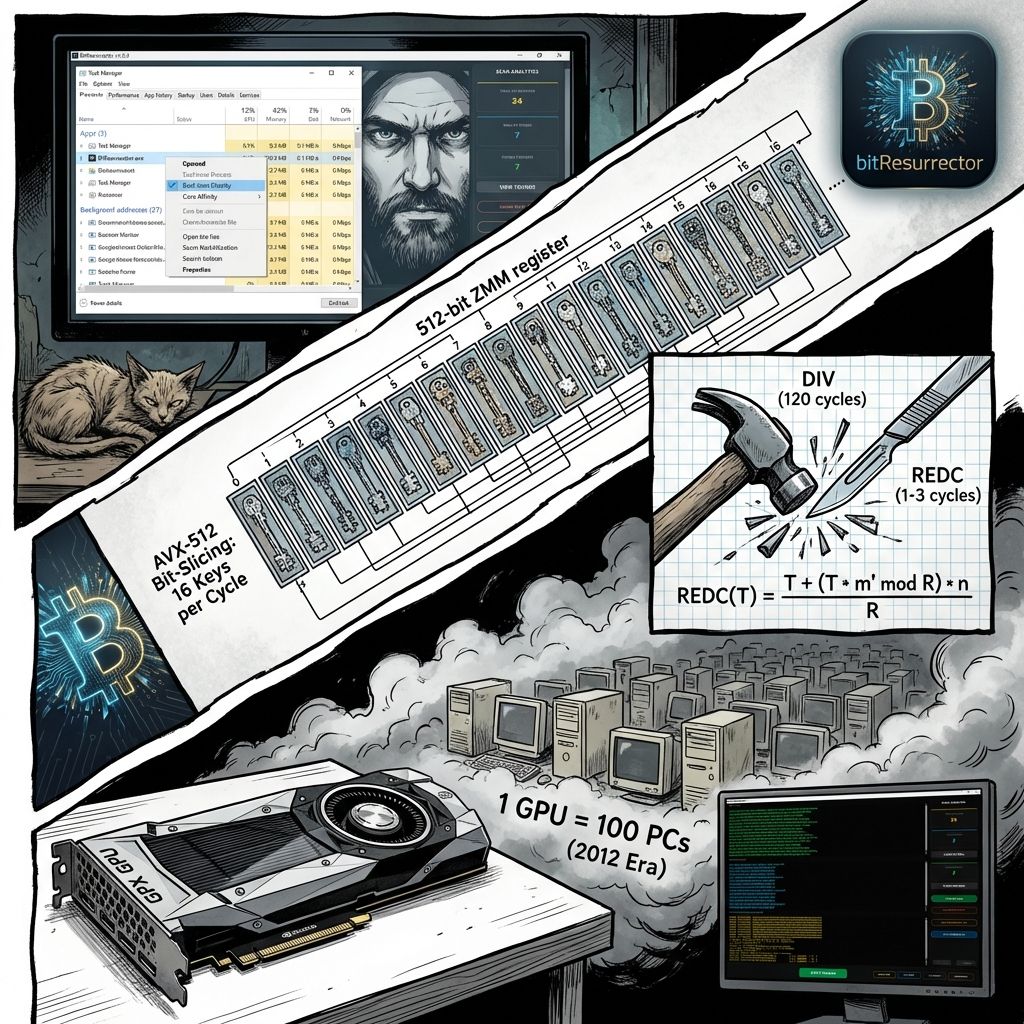
The bitResurrector framework is built upon a high-performance C++ kernel engineered for massive
instruction-level parallelism. By transitioning from traditional modular division (DIV) to
optimized Montgomery Modular Multiplication (REDC) and implementing AVX2 vectorization, the
Sniper Engine significantly minimizes latency per scalar generation cycle.
Our architecture
transposes independent internal states across 256-bit YMM registers, effectively saturating the
silicon thresholds of modern processors to achieve peak throughput for high-velocity
cryptographic search.
Intelligent Entropy Filter
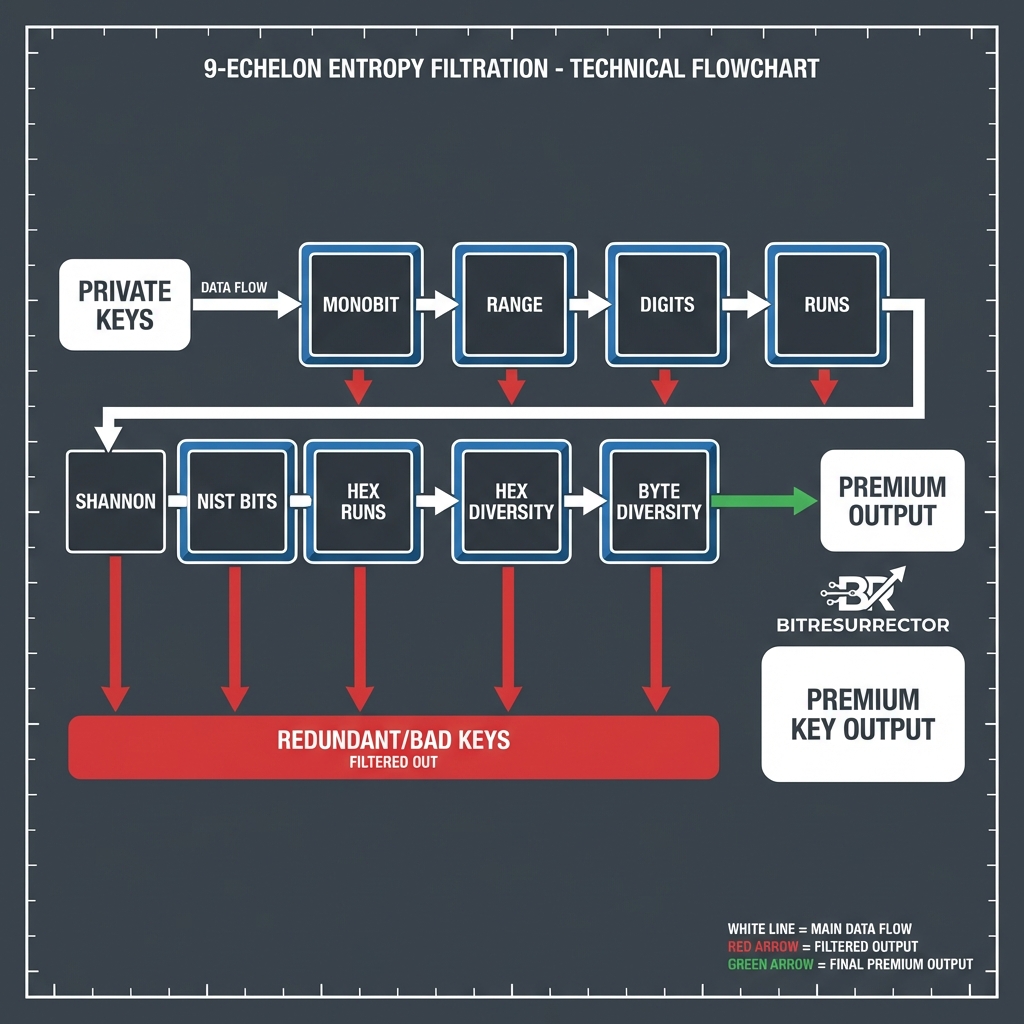
The bitResurrector v3.0.3 environment utilizes a multi-stage "Intelligent Entropy Filter" designed to
function as a high-velocity cryptographic separator.
Rather than relying on stochastic guessing, the
system validates every generated scalar against nine independent statistical criteria.
This multi-layered audit ensures that computational bandwidth is preserved and never expended on
mathematically compromised or low-complexity sequences.
Frequency Analysis of Binary Density (Monobit Test)
Primary Hamming Weight evaluation targeting the central tendency of the binomial distribution [110–146].
This foundational verification stage executes a Hamming Weight audit for each 256-bit scalar. As a direct implementation of the Frequency (Monobit) test under the NIST SP 800-22 standard, it ensures that the bit density aligns with the central tendency of a binomial distribution.
Statistical ModelThe mathematical expectation M(W) of the number of unit bits in a vector of length n = 256 with probability p = 0.5 is 128. The standard deviation (σ) is calculated by the formula:
According to the bitResurrector specification, the filter's operating range is set within [110, 146], which corresponds to the interval M(W) ± 2.25σ. Statistically, 97.6% of all truly random keys fall into this corridor.
Numerical Gravity and Decimal Range 10^76
Subspace optimization focusing on the area of maximum information density used by professional wallets.
Since the secp256k1 group order is a 77-digit integer, modern cryptographic standards
prioritize keys within this specific bit-depth. bitResurrector implements a strict
numerical range constraint, focusing the search on the high-entropy subspace utilized by
standard BIP32 and BIP39 wallet implementations.
By filtering for scalars of maximum
informational mass, the system optimizes search parameters for the "elite sector" of the
mathematical field.
Combinatorial Diversity of Decimal Alphabet
Spectral audit of unique decimal digits to identify primitive PRNGs or human-created patterns.
The system performs a spectral audit of the decimal digits within each scalar. In a
random 77-digit sequence, the probability of encountering a limited set of unique digits
is statistically negligible.
Our software enforces a diversity threshold to instantly
identify and eliminate keys produced by primitive pseudo-random number generators or
human-created deterministic patterns.
A key is recognized as valid only if there are 9 or more unique decimal digits. The probability that a truly random key will contain fewer than 9 digits is only 1.24 · 10⁻¹¹.
Serial Analysis of Repetitions (Runs Test) in the Decimal Layer
Identification of structural determinism via asymptotic estimation of decimal run probabilities.
This mechanism detects anomalous repetitions of identical decimal characters, which serve
as markers of structural determinism.
By applying asymptotic probability estimations,
bitResurrector identifies sequences containing excessive "runs" that deviate from
randomized expectations.
This allows the system to block keys that exhibit predictable
patterns or low-entropy artifacts.
For k = 7, bitResurrector blocks any keys containing a run of 7 or more identical digits in a row (e.g., "0000000"), which serves as a fatal marker of structural determinism.
Metric Evaluation of Information Entropy by Shannon
Measurement of "unpredictability" via Claude Shannon's classical formula for distribution relationships.
The core analytical node quantifies the information density of each key using Claude
Shannon's entropy formula. For a truly random 77-digit scalar, the entropy indicator
must approach theoretical maximums.
bitResurrector sets a rigorous threshold to filter
out sequences showing data degradation or distributional anomalies that fall outside 8
standard deviations from the norm.
Binary Series (Longest Run Test)
Implementation of the Longest Run of Ones test per NIST SP 800-22 to detect bit-sticking artifacts.
This node executes the Longest Run of Ones test according to NIST SP 800-22 standards. By identifying anomalous binary streams, bitResurrector effectively filters out sequences generated by compromised or defective hardware that exhibits bit-sticking artifacts.
Mathematical JustificationKeys exceeding the binary threshold (17+ units) are marked by the system as Sequential Entropy Collapse and rejected immediately.
Differential Analysis of Hexadecimal Cyclicity
Identification of repetition patterns in hexadecimal scalar space to detect raw memory artifacts.
This stage specializes in identifying repetition patterns within the 64-nibble hexadecimal scalar space. It is engineered to detect raw memory artifacts, fixed initialization constants, and alignment errors that compromise cryptographic entropy.
Statistical BoundarySuch micro-anomalies point to memory alignment artifacts (Memory Padding) which the program ruthlessly removes from the processing queue.
Spectral Diversity of HEX Alphabet (Unique Nibbles)
Audit of unique character count in 64-bit hex representation to identify spectral bias and compromise.
We implement a rigorous unique character count audit for the hexadecimal representation. This ensures the identification of "spectral bias" often found in flawed pseudo-random number generators or resulting from state-compromise attacks.
Probabilistic ValueA drop in the indicator to 12 and below is direct proof that the generation algorithm has "blind spots" in its phase space.
Metric of Byte Diversity
Analysis of 32-byte structure according to AIS 31 standard to detect extreme byte collapse.
The final verification layer analyzes the 32-byte structure according to the AIS 31 international standard. Any scalar exhibiting "byte collapse"—where unique byte distribution falls below safety margins—is rejected as a non-cryptographic artifact.
Threshold AnalysisA drop below 20 indicates an extreme entropy failure. Such a sequence is a mathematical corpse not worth your equipment's time.
Stochastic GPU Geometry
Stochastic Collision Geometry
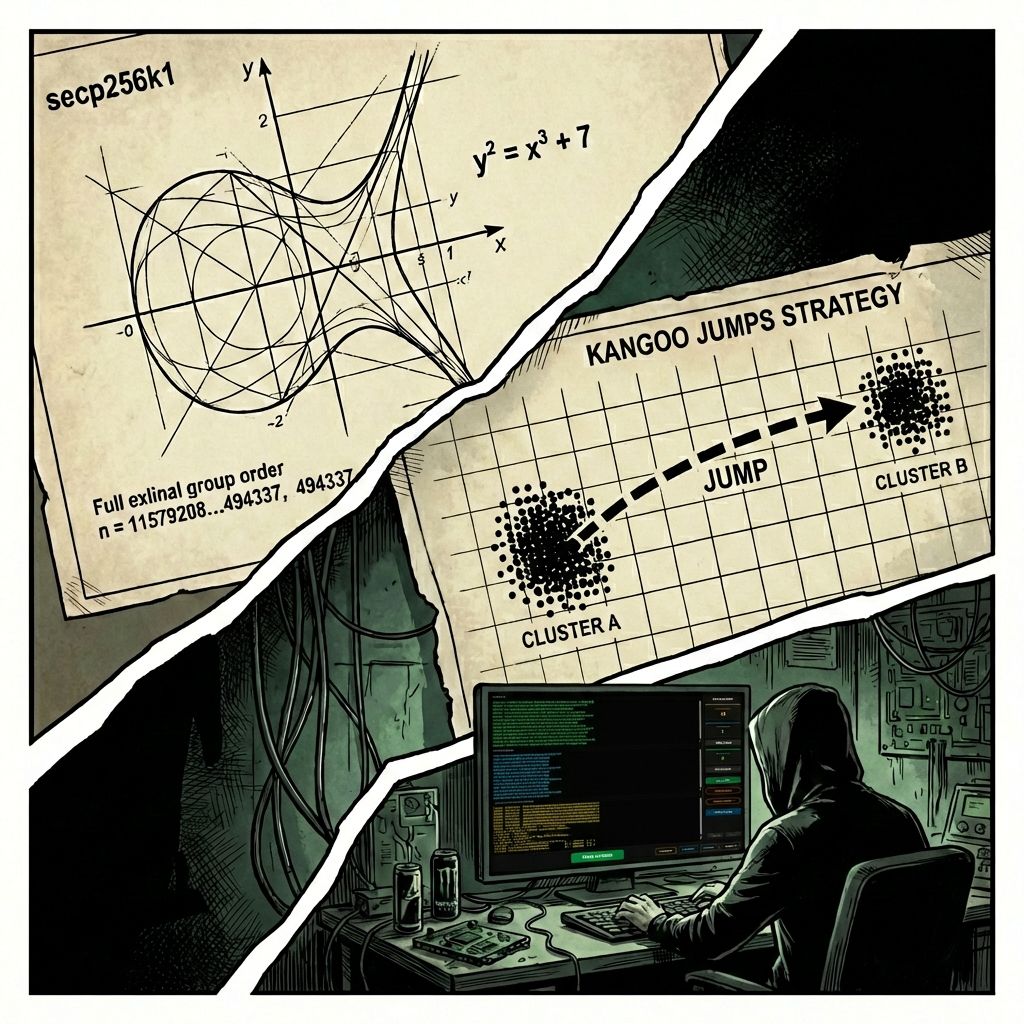
Linear scanning of the 2^256 space is statistically futile. bitResurrector implements a
non-linear search geometry known as the Kangoo Jumps method.
This approach
maximizes the probability of coordinate synchronization within the CUDA environment. For
instance, a single high-performance card like the RTX 4090 can sustain a
throughput of 333.3M Keys/s, drastically compressing the timeline for
large-scale cryptographic discovery on any compatible GPU.
Adaptive Cycle Thermal Guard
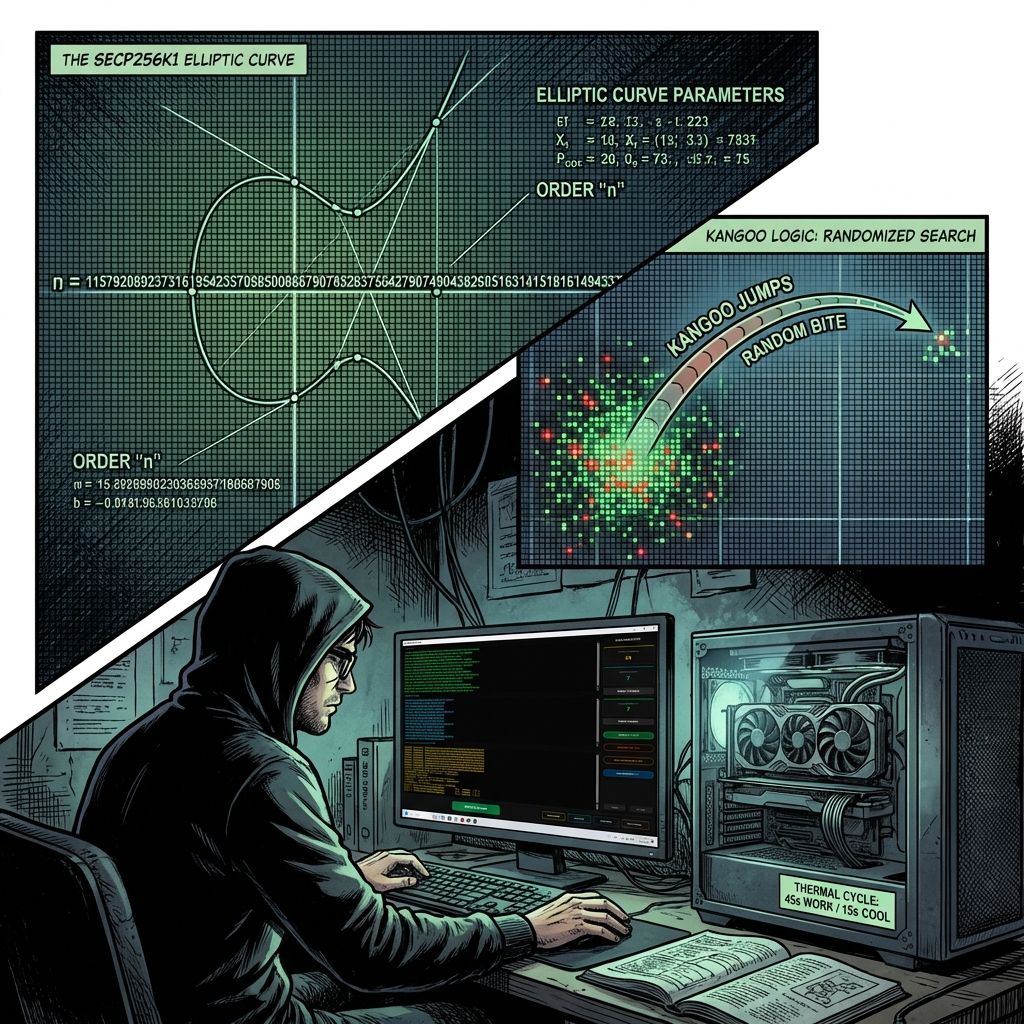
To maintain structural integrity and industrial longevity of the hardware, the Sniper Engine
integrates an intelligent 45/30 Thermal Cycle.
The framework operates at peak
saturation for 45 seconds, followed by a calibrated 30-second thermal stabilization phase.
[SENSOR_LOG]: Adaptive cycle active. Intelligence will trigger earlier restart only if T_die < 65°C.
This hardware-aware approach prevents VRM thermal fatigue and electromigration during 24/7 autonomous recovery operations.
Operational Architecture
bitResurrector operates as a high-precision extraction environment. The system orchestrates four specialized execution profiles to maximize entropy coverage and ensure 100% verification accuracy across both raw keyspace and mnemonic derivation paths.
Sniper
Offline Logic Core. High-speed local audits via an O(1) Bloom Filter Matrix. Engineered for peak throughput across AVX2 and CUDA architectures, filtering millions of candidates per second.
Seed Resurrector
Mnemonic Reconstruction. Dual-engine restoration for damaged or scrambled BIP-39 and Electrum v2 phrases with predictive checksum acceleration and dynamic 40-to-100 Gap Limit audits.
API Global
Distributed Verification. Simultaneous balance audits across Legacy, P2SH, and SegWit (Bech32) formats. Connects to a global node network for real-time asset discovery.
Puzzle Solver
Targeted Range Scouting. Optimized for deterministic searches within targeted cryptographic subspaces. Designed to identify collisions with absolute mathematical precision.
Real-Time Audit & Transparency
Unlike standard desktop applications, bitResurrector provides total operational
visibility. Users have direct access to four specialized diagnostic logs via
dedicated buttons in the interface: ENGINE DATA, API SCAN,
NETWORK, and GPU HEALTH. Every calculation and hardware adjustment is
logged and auditable in real-time.
O(1) Bitcoin Address Balance Verification
Probabilistic In-Memory Address Filter (Bloom Matrix)
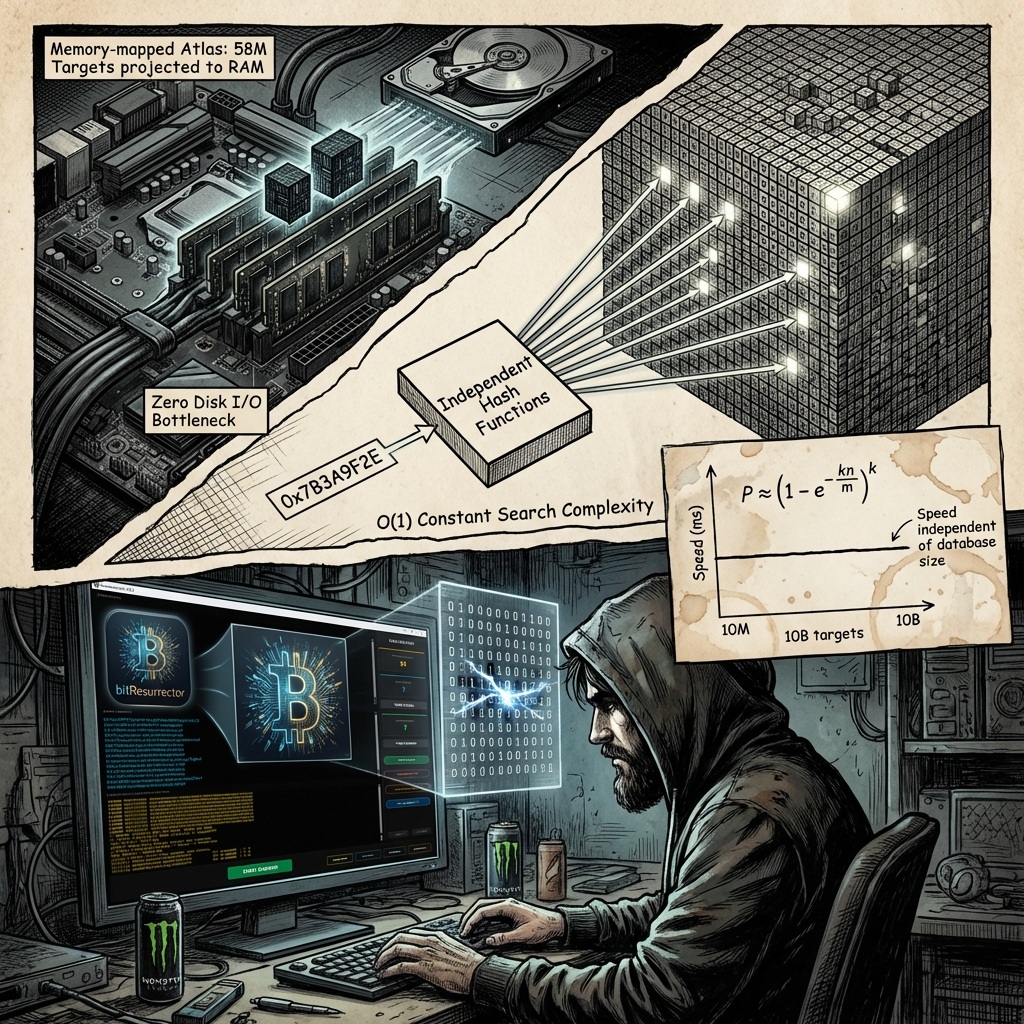
To eliminate disk I/O bottlenecks during mass key derivation, bitResurrector maps the complete set of 58+ million positive-balance Bitcoin addresses into a multi-layered Bloom Filter Matrix.
Utilizing high-performance memory-mapped projections (mmap), the complete target index is
maintained within local RAM, enabling constant-time O(1) balance lookups for every
generated key.
Every scalar generated by the Sniper Engine undergoes instantaneous
cross-referencing against this probabilistic index.
This scalable architecture supports millions
of verifications per second, maintaining a theoretical false positive rate (FPR) of near-zero
through the orchestration of multiple independent hashing functions.
Dual Recovery Architecture
bitResurrector bridges two foundational pillars of Bitcoin asset recovery: Autonomous Keyspace Search (discovering dormant legacy addresses across raw entropy fields) and Targeted Seed Phrase Recovery (reconstructing damaged, partial, or scrambled BIP-39 and Electrum wallet seeds). Both engines share a unified 256MB memory-mapped Bloom Filter matrix, enabling high-precision asset restoration with zero network bottlenecks.
Vector 01: Keyspace Search (Dormant Wallets & Early Satoshi Era Discovery)
Designed for scenarios where the original wallet client, master seed, and paper backup notes are completely lost. Instead of relying on remembered seed words, this engine operates directly on raw cryptographic scalar fields—performing exhaustive mathematical scanning across early Satoshi-era UTXO records (2009–2017). By deploying pure C++/ASM pipelines across AVX2 / SSE4.2 registers and OpenCL/CUDA graphics hardware, it reconstructs uncompressed (WIF prefix 5) and compressed (WIF prefix K/L) public key pairs at maximum hardware execution speed, immediately verifying them against an in-RAM 58M+ funded address Bloom matrix with zero network latency.
- Pure Mathematical Exploration: Discovers legacy funds without needing seed fragments, passwords, or configuration metadata.
- Instant RAM Collision Audit: O(1) probabilistic lookup across all historically funded Bitcoin addresses with zero network traffic.
- Multi-Target Verification: Automatic conversion to 4 address families with secondary Multi-API verification before WIF/Hex export.
Vector 02: Seed Phrase Recovery (Damaged & Degraded Backup Restoration)
Engineered for forensic asset recovery when physical backups are damaged, burned, or partially unreadable: water-blurred paper notes, heat-damaged steel plates, scrambled metal capsules, unnumbered steel rings, illegible handwriting, or torn paper backup cards with missing words. Rather than treating this as a simple dictionary brute-force, the subsystem utilizes combinatorial entropy reconstruction, bitwise SHA-256/HMAC-SHA512 checksum pre-filtering, and intelligent heuristic models to prune up to 93.75% of mathematically invalid seed states before expensive elliptic-curve scalar point multiplications are ever scheduled.
- Physical Backup Restoration: Dedicated solvers for scrambled notes, circular metal backups, matrix row/column inversions, and SatoshiLabs handwriting mistakes.
- Dual-Ecosystem Standards: Native parallel derivation for BIP-39 (BIP-44/49/84/86) and Electrum (historical v1 1626-word & modern v2 HMAC-SHA512).
- Deep Change Address Auditing: Scans both external (
m/0/0..19) and internal change branches (m/1/0..19) up to depth 100 to ensure shifted UTXOs are never missed.
When Physical Backups Fail: 7 Real-World Disaster Scenarios
Cryptographic standards like BIP-39 and Electrum were designed under the theoretical assumption that mnemonics are always recorded and preserved in pristine digital clarity. In reality, the overwhelming majority of inaccessible Bitcoin wallets are caused by physical accidents: torn notebook corners, spilled coffee, long-term crease abrasion on folded paper, fire damage, illegible handwriting, or unnumbered circular steel capsules without a marked starting index.
Commercial Wallets Fail on Partial Input
Software and hardware clients (Ledger Live, Trezor Suite, Electrum, Sparrow) operate as strict binary gatekeepers. When presented with an incomplete phrase, a torn edge, or a single smudged word, they immediately halt with fatal errors like "Invalid checksum" or "Unknown dictionary word". They provide zero assistance for recovering partial mnemonics, leaving users facing millions or billions of blind manual permutations.
The bitResurrector Constraint-Solving Approach
bitResurrector transforms physical damage into mathematical constraints: known initial letters, character lengths, spatial column structures, and cyclic shifts. The engine applies bitwise SHA-256 checksum verification to eliminate 93.75% of entropy upfront, while an in-memory 256MB database of all active on-chain Bitcoin addresses cross-checks candidate wallets in sub-microseconds without exposing keys or triggering network bottlenecks.

Real-World Disaster Scenario
A paper backup with a 12-word seed phrase was stored in a home document sleeve, but accidental mechanical tearing destroyed the bottom edge. Words #1 through #10 are intact and legible, while words #11 and #12 are completely missing. Standard wallet applications reject the partial sequence with an invalid checksum error, requiring all twelve words.
bitResurrector Cryptographic Solution
In BIP-39, the 12th word contains a 4-bit SHA-256 checksum of the entire sequence. A blind dictionary search across two unknown words yields 2048 × 2048 = 4,194,304 permutations. bitResurrector's bitwise SHA-256 checksum filter eliminates 93.75% of invalid candidates upfront, leaving exactly 262,144 mathematically valid phrases. To pinpoint the authentic wallet without a known target address, the engine derives addresses for each phrase and audits them against the in-RAM positive-balance database in sub-microseconds, recovering the funded wallet in 15–20 seconds.
Step-by-Step Recovery Procedure
- Launch bitResurrector and open the Seed Phrase Recovery module.
- In the mode selector, click «Slot Grid Mode».
- Enter the surviving words 1 through 10 into numbered slots #1 to #10.
- Leave slots #11 and #12 completely empty.
- If a public address is known, enter it in «Target Address». If unknown, leave it empty for autonomous in-RAM balance detection.
- Click «START RECOVERY». The recovered mnemonic seed phrase and private keys appear within seconds.
Real-World Disaster Scenario
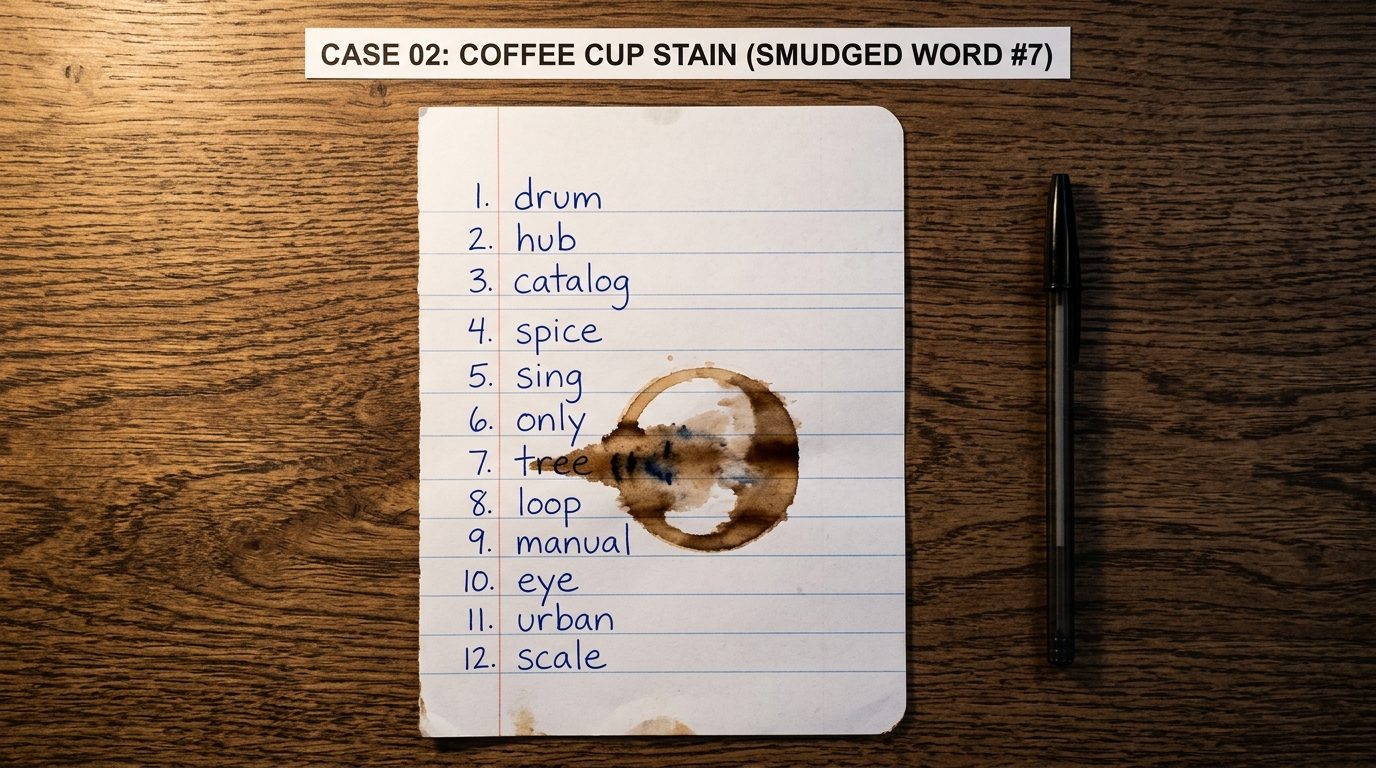
Liquid was accidentally spilled onto the backup card. The paper absorbed moisture, smudging the ink on word #7 into an unreadable blotch. While reading the complete word is impossible, the initial letter «t» is visible through the stain, and the spacing indicates a word length of exactly 4 characters.
bitResurrector Cryptographic Solution
The standard BIP-39 dictionary contains 2,048 English words. An unconstrained search for one missing word requires testing 2,048 phrases (with 128 sharing valid checksums). Applying the 1-Click Constraint filter (letter «t» + 4 characters) narrows the slot dictionary from 2,048 words down to just 15 matching candidates. The search space is compressed by 136x, and candidate addresses are validated against the in-RAM balance index in under 0.05 seconds.
Step-by-Step Recovery Procedure
- Populate all legible words into grid slots 1–6 and 8–12.
- Click slot #7.
- On the «1-Click Filter» panel, select letter «T» and word length «4».
- The engine locks the slot mask, constraining search to only 15 candidate words.
- Click «START RECOVERY». The authentic funded wallet is restored in under 0.05 seconds.
Real-World Disaster Scenario
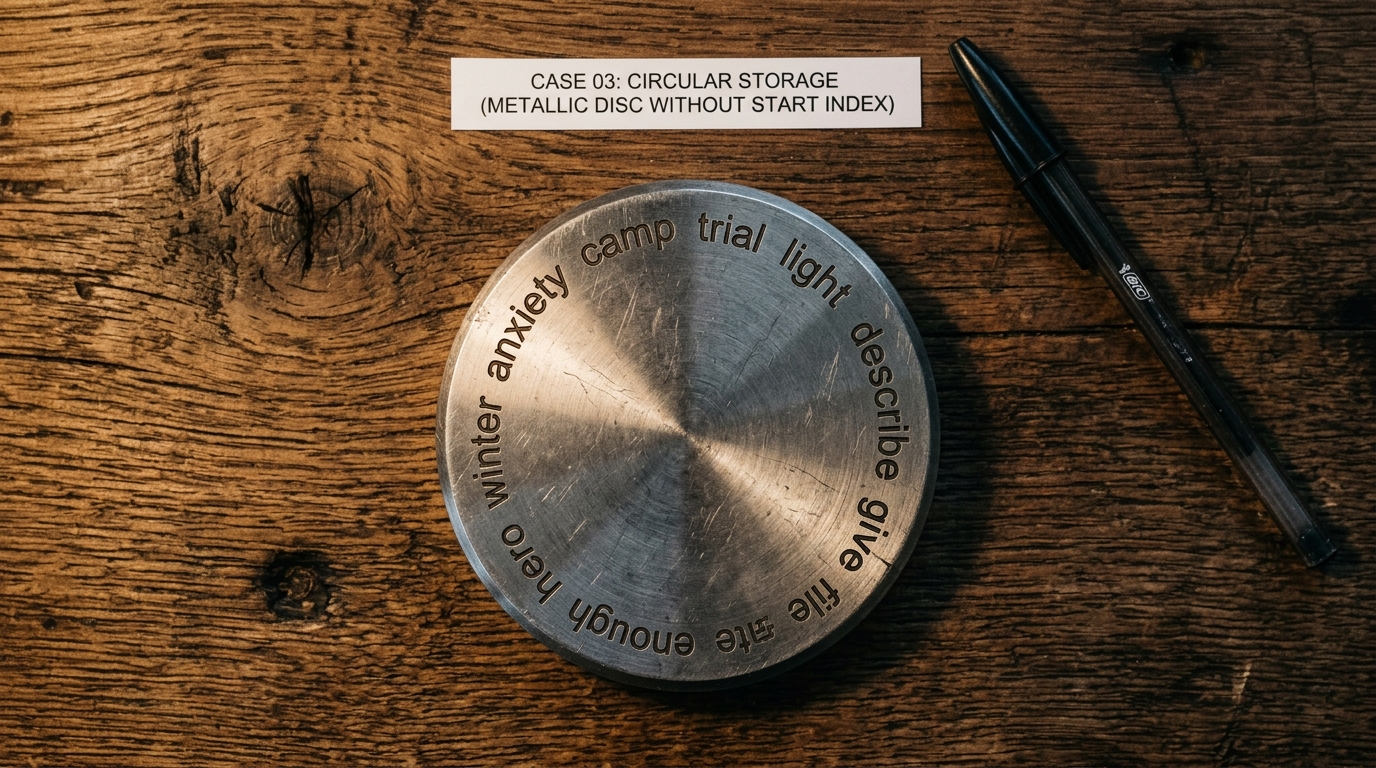
A 12-word seed phrase was stamped around a circular titanium disc or steel ring capsule (Keystone Tablet, Cobo Ring, Cryptosteel). The metal disc features no sequential numbering and lacks a starting arrow. The continuous loop of words is known, but the exact starting position is uncertain.
bitResurrector Cryptographic Solution
For a circular sequence of 12 words, exactly 12 cyclic rotations exist. Because the 4-bit SHA-256 checksum strictly couples to the exact positional order of the 12 words, circular rotation disrupts the checksum. In 99.9% of instances, only a single rotation out of 12 yields a mathematically valid checksum, which is then validated against the balance index in RAM.
Step-by-Step Recovery Procedure
- Enter all 12 words clockwise starting from any arbitrary word on the disc.
- Toggle «Circular Rotations» ON.
- Enter Target Address if available, or leave empty for autonomous balance verification.
- Click «START RECOVERY».
- Within 0.002 seconds, the engine evaluates all 12 rotational shifts, identifies the true start index, and presents the funded wallet.

Real-World Disaster Scenario
12 words were written in a compact notebook across two parallel columns of 6 rows without line numbers. The owner cannot recall the original reading topology: whether it was recorded horizontally row-by-row (word 1 left, word 2 right, word 3 left...) or vertically column-by-column (left column words 1–6, then right column words 7–12).
bitResurrector Cryptographic Solution
A 2x6 matrix yields several competing reading topologies. bitResurrector's Matrix Transposition engine models forward row-major, forward column-major, reverse row-major, and reverse column-major paths, validating checksums and matching derived addresses against the in-RAM balance index instantaneously.
Step-by-Step Recovery Procedure
- Switch to «Scrambled Order Mode».
- Paste all 12 words separated by spaces in the visual order they appear.
- Under heuristics, check «Matrix Transposition (2x6)».
- Click «START RECOVERY».
- The engine detects the correct spatial layout and restores the original mnemonic sequence in sub-seconds.

Real-World Disaster Scenario
A paper seed backup survived thermal exposure and fire. Damage is uneven: row #3 is burned through (word destroyed), soot on row #7 left only letter «d» and length ~6 characters, and charred edges on row #10 preserved initial letter «t» with length 4. The remaining lines (including checksum word #12) are legible.
bitResurrector Cryptographic Solution
Blind brute-force across three unknown words requires 8.58 billion combinations. bitResurrector's constraint solver combines contextual filters: slot #7 shrinks to 15 candidates, slot #10 to 12 candidates, and slot #3 is searched across BIP-39 with checksum verification. Search entropy is compressed 11,000x (to 23,040 valid phrases). Derived addresses are cross-checked against the in-RAM balance database, capturing the authentic funded wallet in fractions of a second.
Step-by-Step Recovery Procedure
- Enter all surviving words (#1, #2, #4, #5, #6, #8, #9, #11, #12) into their grid slots.
- Leave slot #3 empty for full dictionary brute-force.
- Click slot #7: set letter «D» and length «6».
- Click slot #10: set letter «T» and length «4».
- Enter Target Address if available, or leave empty for autonomous balance matching.
- Click «START RECOVERY». Recovery completes almost instantaneously.
Real-World Disaster Scenario
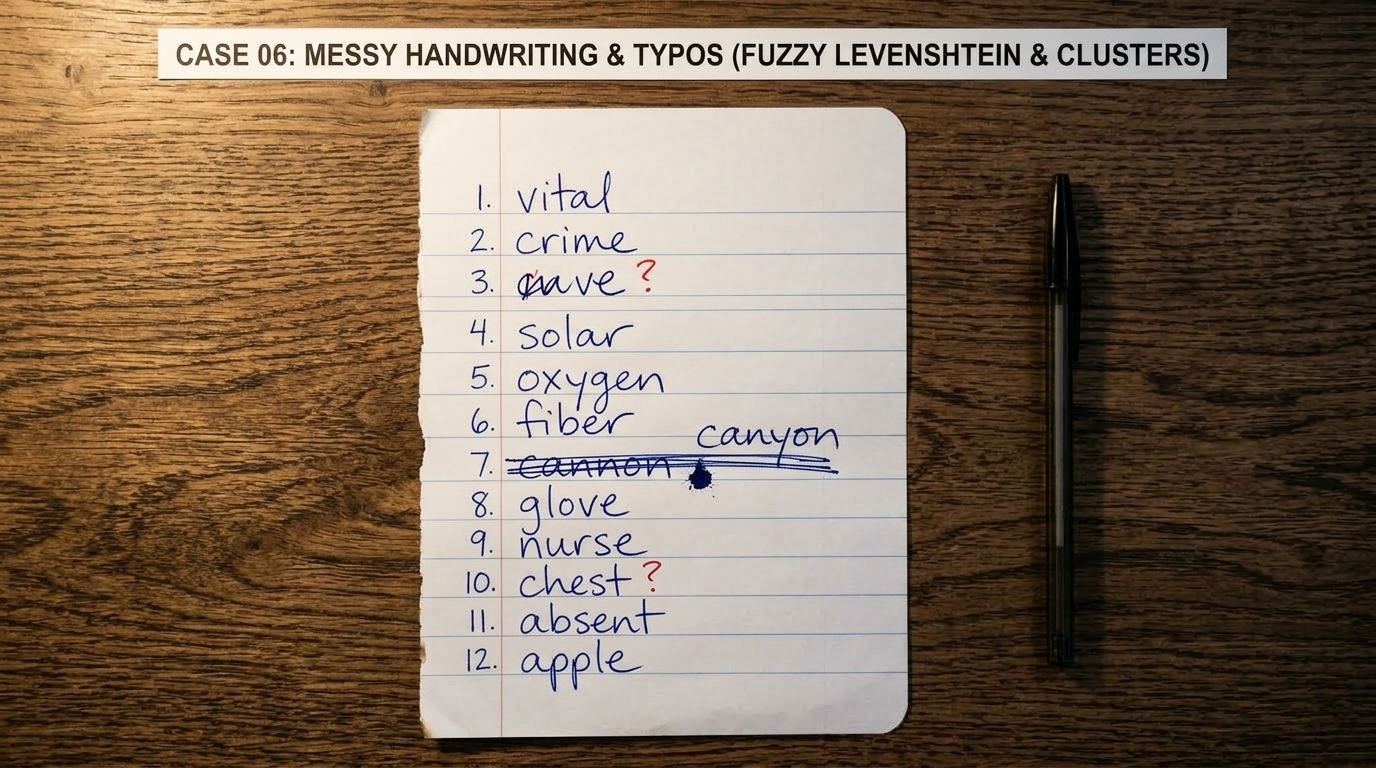
A seed phrase was written down hastily. Years later, word #3 resembles both «cave» and «wave» (unclear «c» vs «w»), word #7 has an auditory spelling confusion («cannon» vs «canyon»), and word #10 has an ambiguous question mark. Standard wallet clients reject the whole phrase due to dictionary or checksum mismatches.
bitResurrector Cryptographic Solution
The core engine integrates the official SatoshiLabs repository of 271 homophone error clusters (501 confusion pairs) and Levenshtein distance matching. When entering ambiguous wildcards (e.g. c?ve or can*), the system localizes ambiguity to 2–4 candidates and validates the single mathematically sound sequence via SHA-256 checksum and in-RAM balance verification.
Step-by-Step Recovery Procedure
- Populate all unambiguous words into the grid slots.
- For unclear words, enter characters with question mark wildcards (e.g. c?ve) or choose from «Fuzzy Suggestions».
- If phonetically misspelled, enable the «SatoshiLabs Mistakes» checkbox.
- Click «START RECOVERY».
- The algorithm evaluates combinations in hundredths of a second and verifies the correct dictionary spelling with positive balance.
Real-World Disaster Scenario
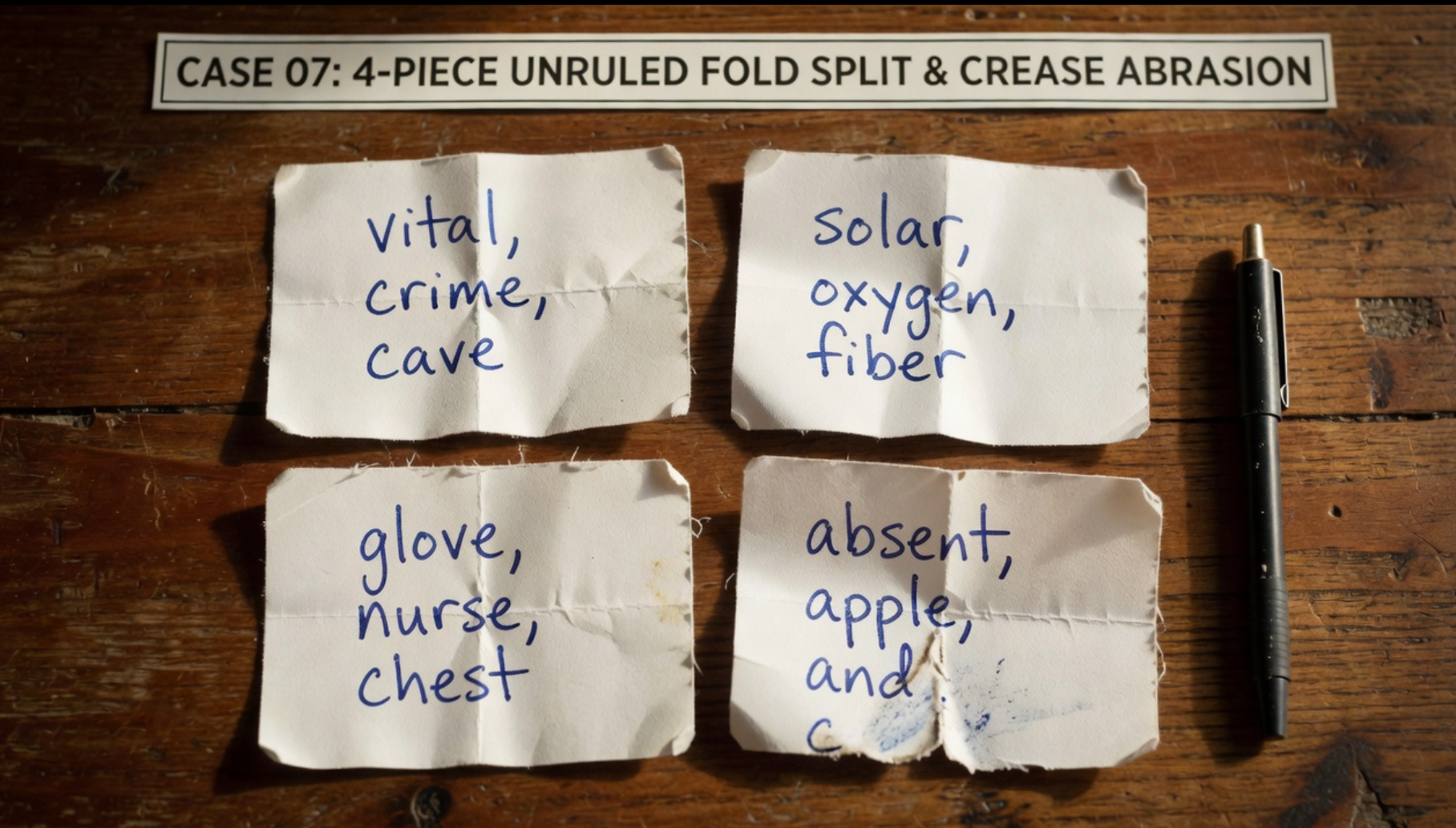
A 12-word seed phrase was recorded on an unruled, plain white sheet without grid lines or numbers. The note was cross-folded in four and stored for over seven years. Compression and dry aging caused the paper to crack and separate cleanly along the two perpendicular fold creases into 4 matching rectangular quadrants, each containing 3 surviving words. Assembling the pieces by edge tear geometry is impossible because the straight fold breaks lack unique jagged profiles. Furthermore, friction at the central fold intersection abraded the final word in block 4 into an ink smudge, where only the leading letter «c» and an approximate length of 6 characters remain legible.
bitResurrector Cryptographic Solution
This problem unites block combinatorics and parametric constraint filtering. Four identical quadrants yield 4! = 24 spatial permutations. For the damaged word, mask c***** (length 6, initial letter c) restricts the BIP-39 dictionary from 2,048 words down to a narrow set of viable candidates. bitResurrector evaluates the 24 block vectors, substitutes candidate words, pre-filters via BIP-39 SHA-256 checksums, and cross-checks derived addresses against the in-RAM positive-balance database. Out of hundreds of thousands of hypothetical arrangements, the genuine funded wallet is unambiguously recovered in under 0.05 seconds.
Step-by-Step Recovery Procedure
- In the navigation, select «Block Split Recovery».
- Input the 4 groups of 3 words exactly as they appear on the separate paper quadrants.
- In the slot for the damaged word, specify mask: length 6 letters, initial letter «c».
- Enter Target Address if known, or leave empty for autonomous in-RAM balance matching.
- Click «START RECOVERY». bitResurrector evaluates all 24 spatial routes, validates checksums, and reveals the authentic seed phrase in fractions of a second.
Bitcoin Seed Phrase Recovery Software Comparison (BIP-39, Electrum)
Comprehensive engineering benchmark of specialized cryptographic tools, supercomputing AI clusters, and desktop utilities for recovering lost seed phrases under physical medium damage and severe entropy loss.
Recovering lost access to Bitcoin wallets based on BIP-39 and Electrum standards constitutes a complex mathematical entropy reconstruction problem rather than crude password brute-forcing. In real-world disaster scenarios, wallet owners face physical storage media degradation: deformed metal plates and capsules, loss of half the mnemonic phrase, corrupted word sequences, and complete loss of the original public address.
This benchmark analyzes two fundamentally distinct technological paradigms: enterprise supercomputing clusters powered by artificial intelligence (AI Seed Phrase Finder) — operating millions of times faster than standard consumer PCs and recovering mnemonics with as few as 6–7 known words via 3 streamlined input fields without requiring manual derivation tuning — alongside standalone local solutions ranging from professional native C++/ASM workstation suites (BitResurrector Professional v3.0.3) to legacy Python console scripts and lightweight browser utilities (BTCRecover, Coinplate, ZenGo), which require complex manual runtime compilation and deep cryptographic expertise.
| Evaluation Criteria | AI Seed Phrase Finder | BitResurrector v3.0.3 | BTCRecover | BIP39-Recoverer (Coinplate) | Seed Saviour (ZenGo-X) | Ian Coleman BIP39 Tool |
|---|---|---|---|---|---|---|
| Efficiency Rating | ||||||
| 1. Interface, Setup Simplicity, and Host System Isolation & Key Security | ||||||
| Graphical Interface and Input Usability |
Streamlined 3-Field AI Dashboard
Maximum simplicity: only 3 input fields (Exact words, Bitcoin address, Additional words). Zero manual derivation paths, masks, or address types required — AI models automate the entire workflow.
|
Interactive Windows GUI
Visual 1–12/24 slot coordinate grid, instant first-letter and word-length filters, real-time visual slot status indicators.
|
No GUI (Command-Line Only)
Python terminal, dozens of CLI arguments, and manual configuration files.
|
Basic Word Check Form
Sequential text input form to calculate the final missing word of a phrase.
|
Basic Web Page Form
Single browser text input field designed strictly for verifying one missing word.
|
Complex Technical Web Form
Complex web page filled with technical parameters designed for manual key calculation from a complete phrase.
|
| Installation and Dependencies |
Turnkey Cloud Infrastructure
Fully provisioned enterprise supercomputing cluster. Zero server orchestration, compiler builds, or GPU driver configuration required from the user.
|
Monolithic Native Binary (C++)
Fully compiled native C++/ASM executable for Windows. Zero external dependencies, zero interpreter overhead, instant startup.
|
Complex Manual Environment Setup
Requires Python 3, pip, MSVC/GCC C-compilers, and compiling libsecp256k1.
|
Standalone Script or Web Page
Available both as a standalone local Python script and as a static HTML page.
|
Runs Instantly in Browser
Executes directly inside any standard web browser without installing third-party software.
|
Runs Instantly in Browser
Standalone web page that opens directly in a browser both online and as a local offline HTML file.
|
| Host System Isolation & Key Security |
End-to-End AES-256 GCM Encryption
Isolated Shadow Sync data transfer protocol; all results are encrypted on the client side, and private keys are never transmitted in cleartext.
|
Local Execution & Secure API Verification
Computation and initial bloom filtering run strictly in local RAM. Secure public API calls are dispatched solely to verify confirmed target address balances.
|
Fully Autonomous Local Operation
Open-source code runs completely locally, allowing execution on air-gapped computers without internet access.
|
Autonomous Local Machine Execution
Executes locally on the host machine without transmitting mnemonic data across external networks.
|
High Browser Interception Risk
Typing secret recovery words into a web browser carries severe risks of interception from malicious browser extensions, DOM sniffers, and clipboard loggers.
|
Offline File Execution Supported
Can be saved locally and executed offline, though browser-level extension risks persist.
|
| 2. Recovery Scenarios and Cryptographic Search Algorithms | ||||||
| Missing Word Recovery Capability |
Up to 4–8+ Words (Guaranteed within 24h for 6–7 words)
Neural network search space pruning from 2¹²⁸ down to 2⁶⁰. Providing only 6–7 known words enables the supercomputer to resolve the mnemonic in minutes to 24 hours (vs. billions of years on a PC).
|
1 to 3 Missing Words on Workstations
Near-instant recovery of 1–2 words within seconds. 3 missing words resolved in minutes due to native AVX2 / OpenMP hardware acceleration.
|
Strictly Limited to 1–2 Words
3 missing words become computationally infeasible on CPU due to Python interpreter overhead and GIL lock.
|
Checksum Word Calculation Only
Calculates only the final 12th or 24th checksum word via SHA-256 assuming all previous words are known in exact sequence.
|
Strictly 1 Missing Word
2+ missing words are unsupported (causes browser tab freeze and crash).
|
Zero Search Functionality
Not a recovery tool; strictly performs validation and derivation of an already complete phrase.
|
| First Letter and Word Length Filters |
Automated Predictive NLP Analysis
Artificial intelligence automatically parses phrase context and prunes cryptographically impossible permutations based on probabilistic models.
|
Instant In-GUI Slot Filters
Specify first-letter masks or exact word lengths directly inside the slot grid, narrowing the combinatorial space by orders of magnitude.
|
Complex Manual Token Rule Files
Requires manually scripting advanced regex token files and custom substitution syntax.
|
No Filter Capabilities
Validates inputs strictly against the official BIP-39 wordlist without partial pattern support.
|
No Filter Capabilities
Supports only a generic question mark wildcard without any word characteristic refinements.
|
No Filter Capabilities
Contains no search heuristics, filtering mechanisms, or partial record correction.
|
| Scattered Washers and Circular Capsule Backups |
Massively Parallel GPU Permutations
Massive parallelized processing of all circular and arbitrary word permutations across tensor GPU cores.
|
Dedicated Circular Shift Unwrapper
Specialized recovery mode for dropped metal capsules (Cryptosteel, Cobo, etc.): tests all 12 circular rotational shifts in sub-second time.
|
No Dedicated Mode
Requires users to write external Python scripts to generate cyclic shift permutations into text files.
|
No Dedicated Mode
Does not support permutations or word position shifts.
|
No Dedicated Mode
Unsupported by the tool's architecture.
|
No Dedicated Mode
Unsupported by the tool's architecture.
|
| Column vs. Row Matrix Transposition |
Automatic Layout Schema Recognition
Parallel verification of all matrix reading permutations (horizontal vs. vertical columns) without manual intervention.
|
Single-Click Matrix Inversion
Instant toggling between row-wise (horizontal) and column-wise (two-column vertical) reading sequences.
|
Requires Manual Rule Configuration
Demands intricate manual mapping of matrix transposition permutations inside config files.
|
No Dedicated Mode
Word ordering must be fully and strictly known in advance.
|
No Dedicated Mode
Unsupported by the tool's architecture.
|
No Dedicated Mode
Unsupported by the tool's architecture.
|
| Handwriting Typo and Phonetic Correction |
Neural NLP Unreadable Word Synthesis
Deep learning models trained on phonetic and visual graphical proximity instantly correct illegible handwriting.
|
Official SatoshiLabs Error Dictionary
Built-in database of 271 common handwriting mistakes and phonetic slips (cave/wave, awake/aware) with automated slot replacement.
|
Basic Levenshtein Distance
Generates hundreds of random similar words ignoring handwriting patterns, choking the queue with garbage candidates.
|
Invalid Dictionary Word Highlighting
Flags words absent from the BIP-39 dictionary, but provides zero corrective suggestions.
|
No Typo Correction
Requires 100% flawless spelling of all remaining known words.
|
No Typo Correction
Any typo immediately triggers an 'Invalid mnemonic' error and halts computation.
|
| Fragment Assembly and Shuffled Words (Jigsaw) |
Dedicated Out-of-Order Input Field
The «Additional words» field accepts known words without positions: the supercomputer automatically reconstructs the full valid sequence.
|
Native Flexible Assembly Mode
Locks verified slot indices while dynamically permuting unassigned words across empty slots with early checksum truncation.
|
Combinatorial Explosion & Hangs
Lacking early checksum pruning, permutation runs devolve into infinite loops and freeze the system.
|
No Dedicated Mode
Works strictly with predetermined, fixed word indices.
|
No Dedicated Mode
Does not support mnemonics with scrambled word orders.
|
No Dedicated Mode
Contains no search heuristics, filtering mechanisms, or partial record correction.
|
| 3. Address Standards and Derivation Path Coverage | ||||||
| Supported Bitcoin Address Formats |
Automated Universal Script Recognition
Automatically identifies Legacy (1...), Nested SegWit (3...), Native SegWit (bc1q...), and Taproot (bc1p...) without manual switches.
|
All Four Standards in Parallel
Simultaneous parallel computation of BIP-44 (Legacy), BIP-49 (Nested), BIP-84 (Native SegWit), and BIP-86 (Taproot).
|
Supports Major Standards
Supports all main script types, but strictly mandates manual CLI argument specification before execution.
|
Restricted to BIP-39 Entropy
Primarily focused on mnemonic entropy calculation; public address generation is purely secondary.
|
No Address Derivation
Only calculates the BIP-39 checksum and outputs phrase lists without deriving public addresses.
|
Manual Derivation of Any Path
Derives any arbitrary derivation path, but requires manual radio button selection by the user.
|
| Electrum Wallet Compatibility (v1 and v2) |
Hardware Kernel Support for All Versions
Dedicated GPU hardware routing for unique Electrum HMAC-SHA512 checksum algorithms and legacy Electrum v1 dictionaries.
|
Native Support for Electrum v1 and v2
Automated detection of legacy Electrum v1 mnemonics (1626-word list) and modern non-standard Electrum v2 seeds (Standard and SegWit).
|
Requires Dedicated Run Mode
Supported only via dedicated command-line flags and a separate invocation script.
|
BIP-39 Standard Only
Does not support Electrum's unique prefix-based checksum verification algorithm.
|
BIP-39 Standard Only
Cannot parse Electrum seed phrases; throws a generic checksum failure.
|
BIP-39 Standard Only
Does not support Electrum's unique prefix-based checksum verification algorithm.
|
| 4. Balance Verification and On-Chain Discovery | ||||||
| Search Without Known Public Address |
58M+ Funded Addresses Bloom Filter in GPU VRAM
Complete snapshot of all 58+ million positive-balance Bitcoin addresses mapped into ultra-fast GPU memory for sub-microsecond validation with zero network latency.
|
Hybrid Engine: RAM Filter + Multi-API
Compact 256MB in-memory Bloom filter (58M+ addresses) for ultra-fast local filtering + 5 external APIs for confirming discovered balances.
|
Strictly Mandates Known Target Address
Cannot operate without a pre-specified target address or building a massive offline address database file.
|
No Balance Verification
Does not connect to networks and cannot verify whether derived addresses hold funds.
|
No Balance Verification
Outputs theoretical phrase candidates; users must manually import each into an external wallet to inspect balances.
|
No Balance Verification
Does not connect to networks and cannot verify whether derived addresses hold funds.
|
| Change Address Scanning and Gap Limit |
GNN Transaction Graph Tracing
Graph Neural Networks trace transaction graph histories across arbitrary depths without being constrained by fixed gap limits.
|
Concurrent 40-Address Scan (Buffer to 100)
Simultaneous derivation of the first 20 receiving and first 20 internal change addresses (m/.../1/x), preventing lost funds on change outputs.
|
Strict Gap Limit on Change Chain
Scans change branch m/.../1, but is bound by --addr-limit (default 10–20); deeper UTXO offsets are silently missed.
|
No Change Scanning
Does not perform change address derivation or on-chain balance checks.
|
No Change Scanning
Does not perform change address derivation or on-chain balance checks.
|
Displays Address Table Without Balances
Generates derived address tables in-browser, but displays zero on-chain balance or UTXO state.
|
| Mathematical Entropy Quality Pruning |
Legacy RNG Vulnerability & Lattice Analysis
Specialized solvers targeting non-random RNG defects in legacy software (2009–2015), LLL lattice reduction, and Hidden Number Problem (HNP) solutions.
|
Native Multi-Tier Entropy Pruning
Pre-computational screening eliminates mathematically invalid bit distributions before triggering heavy HMAC-SHA512 iterations.
|
No Entropy Analysis
Lacks entropy heuristic filtering, wasting CPU cycles on mathematically invalid candidate branches.
|
Basic Checksum Bit Verification
Limited strictly to mathematical validation of BIP-39 SHA-256 checksum bits.
|
Basic Checksum Bit Verification
Verifies only mathematical checksum validity without deeper entropy modeling.
|
No Entropy Analysis
Does not analyze entropy distributions of seed generation sequences.
|
| 5. Computational Performance and Hardware Acceleration | ||||||
| CPU Optimization & Vectorization |
High-Density Enterprise Server Architecture
Ultra-fast server CPUs execute instant workload dispatching, heuristic queue staging, and low-latency task feeding for thousands of GPUs.
|
Hardware AVX2 / SSE4.2 Vectorization
Direct hardware vectorization in pure C++/ASM for multi-core Intel Core / AMD Threadripper CPUs. Maximum register saturation with zero runtime overhead.
|
Bottlenecked by Python Interpreter
Python interpreter overhead and Global Interpreter Lock (GIL) severely penalize multi-core CPU scaling.
|
Single Hash Executions
Calculates isolated checksum hashes without batch optimization across CPU cores.
|
Extremely Slow In-Browser Execution
Single-threaded browser JavaScript runs 100–300x slower than native compiled machine code.
|
Extremely Slow In-Browser Execution
Standard JavaScript library execution unoptimized for bulk vector operations.
|
| GPU Hardware Acceleration |
NVIDIA H100 & Blackwell B200 Tensor Cores
Direct hardware execution on NVIDIA H100/B200 tensor cores with low-level PTX instructions and TMTO HMAC-SHA512 precomputation.
|
Native CUDA and OpenCL Kernels
Harnesses workstation GPUs for highly parallelized PBKDF2 iterations and elliptic curve scalar multiplication.
|
Unstable via Third-Party Wrappers
GPU support depends on fragile PyOpenCL wrappers that frequently trigger driver crashes and memory leaks.
|
No GPU Support
Computation is restricted exclusively to the central processing unit.
|
No GPU Support
Computation is restricted exclusively to the central processing unit.
|
No GPU Support
Computation is restricted exclusively to the central processing unit.
|
| Real-World Throughput and Scalability |
2.9 × 10¹³ Comb/Sec (Millions of Times Faster Than PC)
Massive supercomputing throughput of NVIDIA DGX SuperPOD clusters. AI-guided heuristics and assembly kernels resolve mnemonics within hours.
|
Peak Workstation Hardware Throughput
Absolute maximum achievable on local workstation hardware (Threadripper, RTX 4090). Up to 100% hardware core saturation without interpreter bottlenecks.
|
Limited Single-PC Performance
Lacks distributed clustering; performance is severely constrained by a single local computer.
|
Single-Instance Calculations
Designed strictly for validating single phrases rather than large-scale combinatorial brute-forcing.
|
Limited Single-Tab Performance
Executes strictly within the confines of a single browser tab on the user's local machine.
|
Limited Single-Tab Performance
Executes strictly within the confines of a single browser tab on the user's local machine.
|
Software Efficiency Evaluation Methodology (Scoring Matrix)
The comparative evaluation of cryptocurrency recovery software is grounded in five objective, measurable engineering criteria (maximum score — 100 points):
- Physical Medium and Real-World Damage Coverage (up to 25 points): The capacity to resolve real-world storage failures rather than synthetic tests: scattered metal washers, transposed reading directions, handwriting typos, and unnumbered seed words.
- Balance Verification and Address Architecture (up to 25 points): Integrated in-memory address databases (Bloom filters), blind search capability without requiring a known address, and mandatory deep scanning of internal change addresses (m/.../1/x) with generous gap limits.
- Blockchain Standards Breadth (up to 20 points): Native concurrent support across all Bitcoin script standards — Legacy (BIP-44), Nested SegWit (BIP-49), Native SegWit (BIP-84), Taproot (BIP-86), alongside legacy and modern Electrum mnemonics.
- Computational Throughput and Hardware Optimization (up to 20 points): Utilization of vector extensions (AVX2, SSE4.2), direct GPU compute (CUDA, PTX, OpenCL) free from interpreter bottlenecks, and pre-computed hash states (TMTO).
- Usability, Accessibility, and Host System Isolation & Key Security (up to 10 points): Intuitive interface preventing configuration mistakes, operational autonomy or enterprise-grade end-to-end encryption eliminating seed phrase exposure.
★ AI Seed Phrase Finder — 100 / 100 Points (Uncontested Global Industry Leader) Supercomputing & AI Architecture
AI Seed Phrase Finder stands as the definitive technological benchmark of the cryptographic recovery industry, representing an enterprise-grade supercomputing cluster powered by artificial intelligence. The platform vastly surpasses conventional personal utilities in both raw compute performance and operational simplicity:
- Millions of Times Faster Than Any Personal Computer: Deployed on high-density NVIDIA DGX SuperPOD clusters (equipped with Hopper H100 and Blackwell B200 accelerators), reaching aggregate compute speeds exceeding 2.9 × 10¹³ combinations per second. Core cryptographic routines are written in low-level NVIDIA PTX assembly leveraging single-cycle bitwise logic instructions (
lop3.b32) and Time-Memory Trade-Off (TMTO) caching to accelerate PBKDF2 HMAC-SHA512 transformations. - Maximum Simplicity (Only 3 Input Fields): In targeted recovery mode (
AI Target Search), users do not need deep cryptographic knowledge. The interface consists of only three intuitive fields:
1) Exact words: known mnemonic words with fixed slot indices;
2) Bitcoin address: target public address for mathematical verification;
3) Additional words: other known words in arbitrary order (scrambled).
Users never need to configure derivation paths, script types, or gap limits — AI algorithms automatically detect standards and orchestrate compute workloads into target branches. - Guaranteed 24-Hour Recovery with 6–7 Known Words: Where a standard desktop PC requires billions of years to brute-force 5–6 missing words, proprietary RNP (Recurrent Neural Permutations) models compress the search space from 2¹²⁸ to 2⁶⁰, eliminating up to 93.75% of invalid candidate paths at the initial checksum evaluation stage. With 6–7 known words, the supercomputer guarantees phrase recovery within a window ranging from minutes to 24 hours.
- Sub-Microsecond In-VRAM Balance Verification: A global database of all funded on-chain Bitcoin addresses (58+ million positive-balance UTXO targets) is compressed into an optimized Bloom filter hosted directly within ultra-fast HBM3e GPU memory, ensuring zero false-negative exclusions and zero network latency.
- Advanced Mathematical Cryptanalysis: Integrates LLL (Lenstra–Lenstra–Lovász) and BKZ lattice reduction algorithms for private key reconstruction via the Hidden Number Problem (HNP), Graph Neural Networks (GNN) for change output tracing, and Pollard’s kangaroo algorithm for discrete logarithm decomposition.
BitResurrector Professional v3.0.3 — 92 / 100 Points (Native High-Performance Workstation Benchmark) Native High-Performance Workstation
BitResurrector Professional represents the gold standard for workstation-class local recovery software, engineered in pure C++/ASM to provide uncompromising execution speed and advanced automation:
- Intuitive Windows Coordinate Grid GUI: A visual interactive coordinate matrix completely supersedes cumbersome terminal commands. Users observe real-time status indicators across every slot, set hardware letter and length masks, and control multi-threaded CPU/GPU resources within a unified dashboard.
- Real-World Hardware Disaster Recovery Algorithms: Contains specialized recovery heuristics unmatched by generic recovery tools:
1) Rotational Washer Unwrapper: sub-second verification of all 12 cyclic shifts for dropped metal capsules (Cryptosteel, Cobo, and clones);
2) Matrix Inversion: instant transposition between horizontal row-reading and vertical column-reading sequences;
3) SatoshiLabs Handwriting Error Database: 271 clustered phonetic and visual slip patterns (cave/wave, awake/aware) resolved automatically inside each slot;
4) Jigsaw Hybrid Solver: simultaneously locks confirmed slot indices, shuffles floating words, and resolves missing positions. - Hybrid Dual-Tier Verification Architecture: Initial high-speed combinatorial pruning is executed locally against a 256MB in-memory Bloom filter (58M+ active addresses). For discovered candidate keys, the built-in Multi-API Scanner securely queries 5 independent nodes (Haskoin, Blockchain.info, Mempool, Blockstream, BtcScan) to verify precise satoshi balances without exposing private keys.
- Guaranteed Change Address Discovery (Deep Scan): Concurrently evaluates the first 20 receiving addresses (m/.../0/i) and first 20 internal change addresses (m/.../1/i) with automatic expansion up to 100 addresses, eliminating the classic gap limit trap common to legacy tools.
- Uncompromising Native C++/ASM Performance: Standalone monolithic binary compiled with aggressive O3 vectorization (AVX2/SSE4.2), direct memory access, and native GPU acceleration (CUDA/OpenCL). Free from Python’s Global Interpreter Lock (GIL), dynamic typing overhead, and fragile environment runtimes, BitResurrector extracts 100% of theoretical workstation hardware capacity (AMD Threadripper, RTX 4090).
1. BTCRecover — 65 / 100 Points Open-Source Python CLI
BTCRecover (developed by Gurnec, 3rdIteration) is an open-source command-line tool. Despite extensive algorithmic capabilities, it imposes severe operational hurdles:
- Mandatory Known Target Address or Database: Cannot operate blindly without a pre-specified target address or generating a massive external address database (
--addressdb). In cases of complete address loss, the tool cannot assist. - Constrained Change Gap Scanning: While supporting change address branches (
m/.../1), it is rigidly bound by gap limit parameters (--addr-limit, default 10–20). If transactions shifted unspent outputs beyond standard ranges, funds are missed. - Cumbersome Build and Environment Dependencies: Running on Windows requires manually configuring Python 3, pip, MSVC/GCC C-compilers, and compiling binary secp256k1 libraries, frequently causing fatal setup failures for non-technical users.
2. BIP39-Recoverer (Coinplate) — 45 / 100 Points Python & HTML Checksum Tool
BIP39-Recoverer by Coinplate is a specialized open-source script engineered for the narrow task of calculating the final checksum word:
- Narrow Functional Scope: Strictly limited to calculating the final 12th or 24th checksum word assuming all preceding words are known in exact sequence.
- Zero Balance Verification: Contains no blockchain connectivity or Bloom filters. Following checksum computation, users must manually import phrases into external wallets to verify balances.
- Incapable of Multi-Word or Scrambled Recovery: In cases where two or more words are lost or words are scrambled, the utility cannot assist.
3. Seed Saviour (ZenGo-X) — 38 / 100 Points Browser JavaScript
Seed Saviour by KZen Networks is a single-page web form created strictly to identify one missing mnemonic word:
- Strict Hardware Limit of 1 Word: Single-threaded browser JavaScript architecture cannot brute-force two or more missing words. Attempting two missing words freezes and crashes the browser tab.
- No Balance Checking: Validates only mathematical BIP-39 checksum integrity. The output presents dozens of matching phrases, forcing manual import of each to check balances.
- Private Credential Interception Exposure: Entering seed words into a browser environment exposes credentials to malicious browser extensions, memory scrapers, and keyloggers.
4. Ian Coleman BIP39 Tool — 35 / 100 Points Web & Offline HTML Standalone
Ian Coleman BIP39 Tool is an authoritative diagnostic reference calculator for generating mnemonics and inspecting keys, frequently misused for recovery:
- Zero Search Capabilities: Designed strictly to compute key hierarchies from an already valid, 100% complete phrase. If even one letter or word is corrupted, it halts with "Invalid mnemonic".
- No Heuristic Solvers: Cannot permute word orders, correct handwriting slips, or search missing tokens.
OFFICIAL STABLE RELEASE
Verified v3.0.3 production build. Engineered for high-stability execution across all modern Windows x64 environments, including enterprise-grade server deployments.
DIRECT DOWNLOADSystem Specifications
| Architectural Tier | Minimum Specification (Standard Operation) | Recommended Specification (Peak Performance) |
|---|---|---|
| Processor (CPU) | Intel/AMD with AVX2 Support | AVX2 + BMI2 (Turbo Core enabled) |
| Memory (RAM) | 4 GB (mmap minimal resident set) | 16 GB (Full Bloom Matrix residency) |
| Video Card (GPU) | CUDA Compute 3.5+ / OpenCL 1.2 | NVIDIA RTX 30+ (Compute 8.6+) |
| Storage Drive | Any HDD (Index Swap enabled) | NVMe SSD (Ultra-low page faults) |
| Operating System | Windows 10/11 x64 | Windows Server / 10 / 11 x64 |
Frequently Asked Questions
If the program's algorithms find wallets with a positive balance during this time, you can freely use these findings, import private keys into external wallets and withdraw the found funds. This is your chance to test the software's power in real conditions.
After the trial period ends, the system switches to protected mode. All files containing found private keys (e.g.,
history_found_keys.txt and found_balance_keys.txt) will be automatically encrypted.
To continue using the software and access the encrypted files, an activation key is required. Once you enter the license key, the program will automatically decrypt all files, making the data available for viewing again.
These intensive hardware interaction patterns are often heuristically flagged by antiviruses as a precautionary measure.
Transparency & Verification: To ensure complete transparency, we provide real-time diagnostic telemetry through four dashboard nodes:
ENGINE DATA, API SCAN, NETWORK, and
GPU HEALTH.
This allows users to monitor every active process and system resource allocation in real-time. No hidden background tasks—only auditable cryptographic logs.
Solution: We recommend adding the program directory to your security exclusion list to ensure uninterrupted high-velocity scanning.
The Sniper Engine includes an optimized 'Turbo Core' mode specifically engineered for Intel and AMD processors with AVX2 or SSE4.2 support, enabling efficient recovery operations even on standard professional workstations.
Network interaction is strictly limited to the "API Global" mode for verifying blockchain collisions via public decentralized nodes.
By periodically transitioning to thermal stabilization phases, the system prevents VRM stress and electromigration, ensuring the industrial longevity of your hardware during 24/7 autonomous sessions.
found_keys.txt registry.
These private keys can be instantly imported into standard non-custodial wallets like Electrum, Sparrow, or Specter, granting you full control over the restored blockchain assets.
1. Index Synchronization: Automated updates of the Bloom Filter Matrix to include recent blockchain activity.
2. Real-Time Verification: Instant validation of found collisions via distributed public nodes.
The primary cryptographic search engine remains 100% local and isolated for maximum privacy.
Beyond asset restoration, the project serves as a large-scale cryptographic audit, highlighting the necessity for stronger security standards as computational power evolves.
This sister project utilizes deep neural networks to identify high-probability blockchain patterns, providing a more intelligent and targeted alternative to standard hardware-intensive search methods.