

Briefly
- Shadow library Anna's Archive has "backed up Spotify," scraping 86 million audio recordsdata amounting to 300TB of information.
- The group claims to be constructing a "music archive primarily aimed toward preservation."
- Information reveal that Digital/Dance is the biggest style class by artist rely, adopted by Rock and World/Conventional.
Anna's Archive, the shadow library greatest recognized for making pirated ebooks and tutorial papers searchable, introduced this weekend what may be the biggest music piracy operation in historical past: "We backed up Spotify."
The group claims it scraped 86 million audio recordsdata from Spotify, representing 99.6% of every part folks really hearken to on the platform. Complete dimension: just below 300 terabytes, distributed via bulk torrents.
Spotify isn't blissful. A spokesperson instructed Billboard that "a 3rd get together scraped public metadata and used illicit ways to bypass DRM to entry a few of the platform's audio recordsdata." Notice the cautious wording there: "some" audio recordsdata. Anna's Archive says 86 million. Spotify isn't confirming the dimensions. The corporate additionally known as the group "anti-copyright extremists" who had beforehand pirated content material from YouTube.
So, except for ripping off Spotify—and the recording artists, whose earnings is predominantly derived from royalty funds—what precisely did they get?
The parents at Anna's Archive scraped and archived Spotify. It will likely be distributed in bulk torrents over the approaching month.
"Together with your assist, humanity’s musical heritage will probably be perpetually shielded from destruction by pure disasters, wars, funds cuts, and different catastrophes" pic.twitter.com/Ez2pf8GoJS
— Chicago Commune (@chicago_commune) December 21, 2025
The numbers
Anna's Archive claims metadata for 99% of Spotify’s library of 256 million tracks, together with audio recordsdata for the 86 million songs that truly matter—those folks play. The metadata database alone accommodates 186 million distinctive ISRCs (Worldwide Customary Recording Codes). For comparability, MusicBrainz, the biggest authorized open music database, has about 5 million. Anna's Archive simply constructed one thing 37 occasions greater.
Widespread tracks have been preserved of their authentic OGG Vorbis format at 160 kilobits per second—no re-encoding, no high quality loss. Much less common stuff obtained compressed to OGG Opus at 75 kbps to save lots of house. The group used Spotify's personal recognition metric to prioritize what to seize first, specializing in tracks with recognition scores above zero.
Over 70% of Spotify's 256 million tracks have a recognition rating of precisely zero. No person listens to them. The highest 10,000 songs span recognition scores of 70-100. Solely about 210,000 songs—roughly 0.1% of the catalog—have a recognition rating of fifty or greater. These 0.1% account for the overwhelming majority of all listening exercise.
The highest three songs on Spotify proper now? Girl Gaga and Bruno Mars's "Die With A Smile" (3.07 billion streams), Billie Eilish's "BIRDS OF A FEATHER" (3.13 billion), and Dangerous Bunny's "DtMF" (1.12 billion). These three tracks alone have extra complete performs than the underside 20 to 100 million songs mixed.
In different phrases, Spotify is generally a graveyard of songs no person will ever hear. The group determined to not archive that graveyard (the complete catalog)—it might have required an extra 700 terabytes of storage for content material representing simply 0.04% of listening exercise. A lot of it’s AI-generated slop anyway.
The bizarre stuff within the information
Anna's Archive printed in depth evaluation of what they discovered. A few of it’s predictable. A few of it’s unusual.
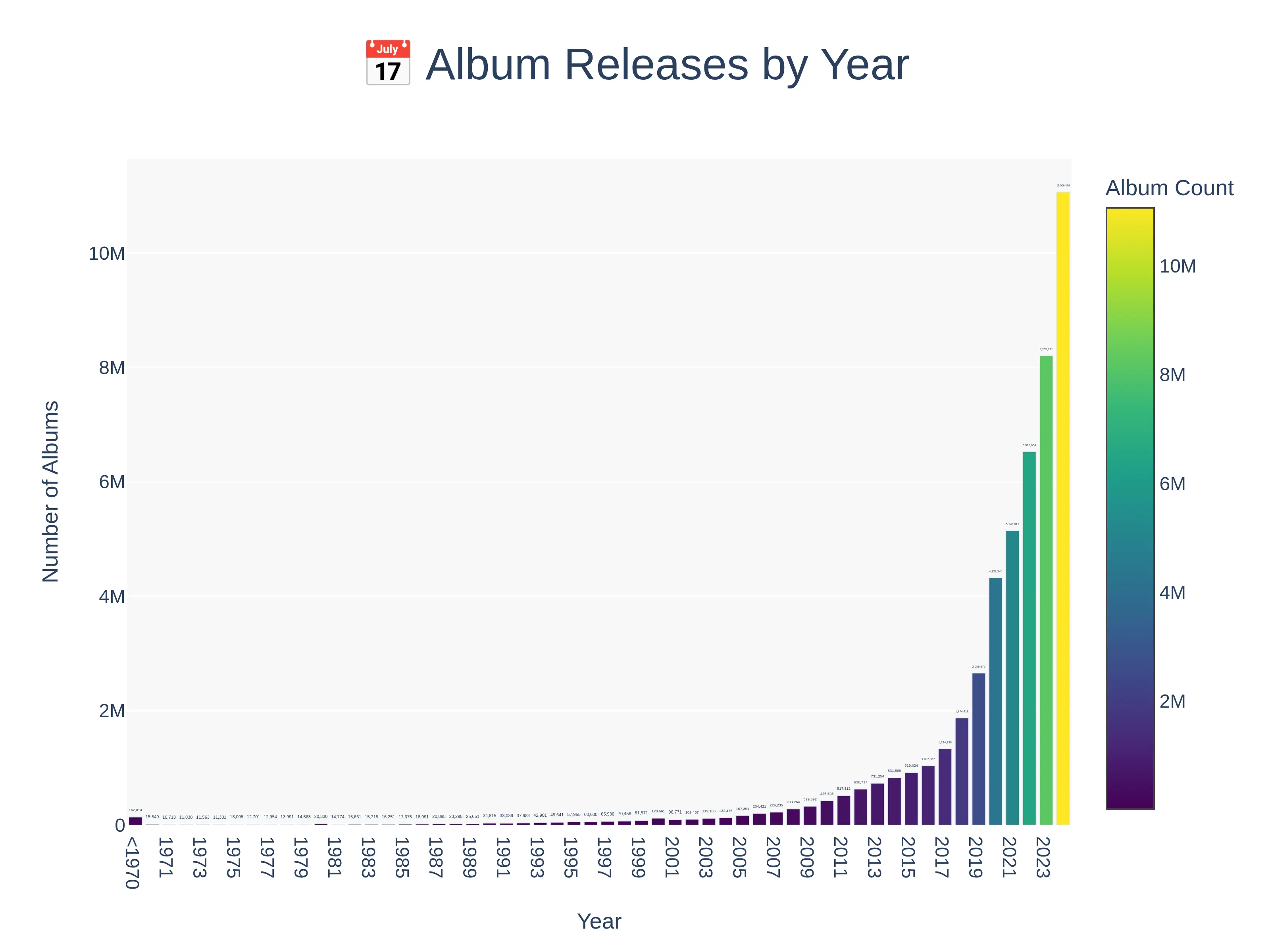
Observe durations cluster sharply at precisely 2:00, 3:00, and 4:00 minutes. The group says they don't know why. Album releases have exploded exponentially since 2015, with over 10 million albums dated 2023 alone—probably pushed by AI era and automatic uploads.
Digital/Dance is the biggest style class by artist rely (520,075), adopted by Rock (370,179) and World/Conventional (202,529).
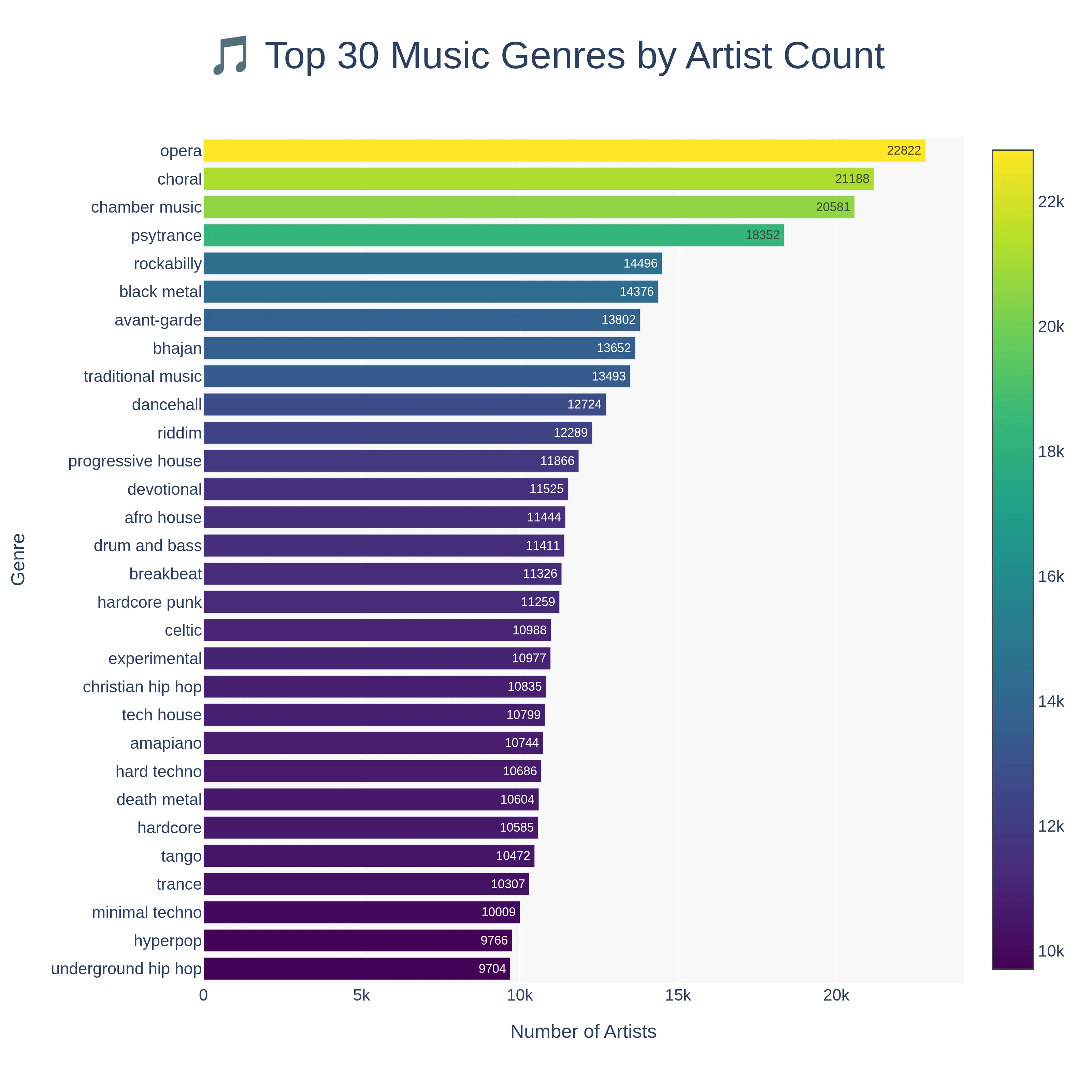
Additionally, consider it or not, Opera, choral, and chamber music have probably the most artists per particular sub-genre.
The audio options information reveals that loudness correlates strongly with power (no shock), BPM clusters round 120 with a standard distribution, and most tracks have low "speechiness" and "instrumentalness" scores—which means vocals dominate. C main and G main are the most typical keys. About 13.5% of all tracks on Spotify are tagged as express content material.
Why do that?
Anna's Archive frames it as preservation, not piracy. "We noticed a job for us right here to construct a music archive primarily aimed toward preservation," the weblog submit reads. The group argues that present music archiving efforts focus too closely on common artists and audiophile-quality codecs (lossless FLAC), leaving obscure music susceptible to vanishing if platforms change insurance policies or shut down.
There's some reality to that. Spotify controls 256 million tracks and may take away content material, change licensing phrases, or disappear completely. Decentralized torrent distribution creates redundancy that may't be shut down by any single entity. The info is already unfold throughout hundreds of torrent nodes worldwide.
However let's be actual. That is additionally simply piracy. Spotify pays artists someplace between $0.003 and $0.005 per stream. In accordance with Dittomusic’s Spotify income calculator, 1 million reproductions would yield an artist $4,370 in royalties. Free distribution by way of torrents eliminates even that minimal compensation.
Each issues are true without delay.
The authorized meteor is coming
Anna's Archive already faces mounting authorized stress. Belgium issued blocking orders with fines as much as €500,000 in July 2025. The UK secured Excessive Court docket blocks in December 2024. Germany's main ISPs blocked the positioning's predominant domains in October 2025. In accordance with its personal transparency report, Google has eliminated 749 million Anna's Archive URLs from search outcomes—that's 5% of all DMCA takedown requests the search engine has obtained since 2012.
The Web Archive—a authentic nonprofit—settled a lawsuit over its Nice 78 Mission for digitizing out of date 78rpm data after publishers sought $621 million in damages. Anna's Archive simply archived 31,000 occasions extra tracks, all present, all in-demand. The music trade's authorized response will make the Web Archive case look quaint.
On Hacker Information, commenters debated whether or not the archive would really be helpful for customers given Spotify's comfort. One identified that Anna's Archive already provides "enterprise-level" entry to its ebook archives for tens of hundreds of {dollars}—primarily promoting bulk information entry to AI firms for coaching.
For now, solely metadata has been totally launched. The audio recordsdata are rolling out progressively via bulk torrents, beginning with the most well-liked tracks. Anna's Archive requested customers to assist seed the torrents and talked about they could add particular person file downloads if there's sufficient curiosity.
The lawsuits are in all probability coming. The one query is whether or not the archive survives them—and at this level, it in all probability doesn't matter. The info is already on the market, distributed throughout hundreds of nodes that may't be centrally shut down. That's the entire level of torrents.